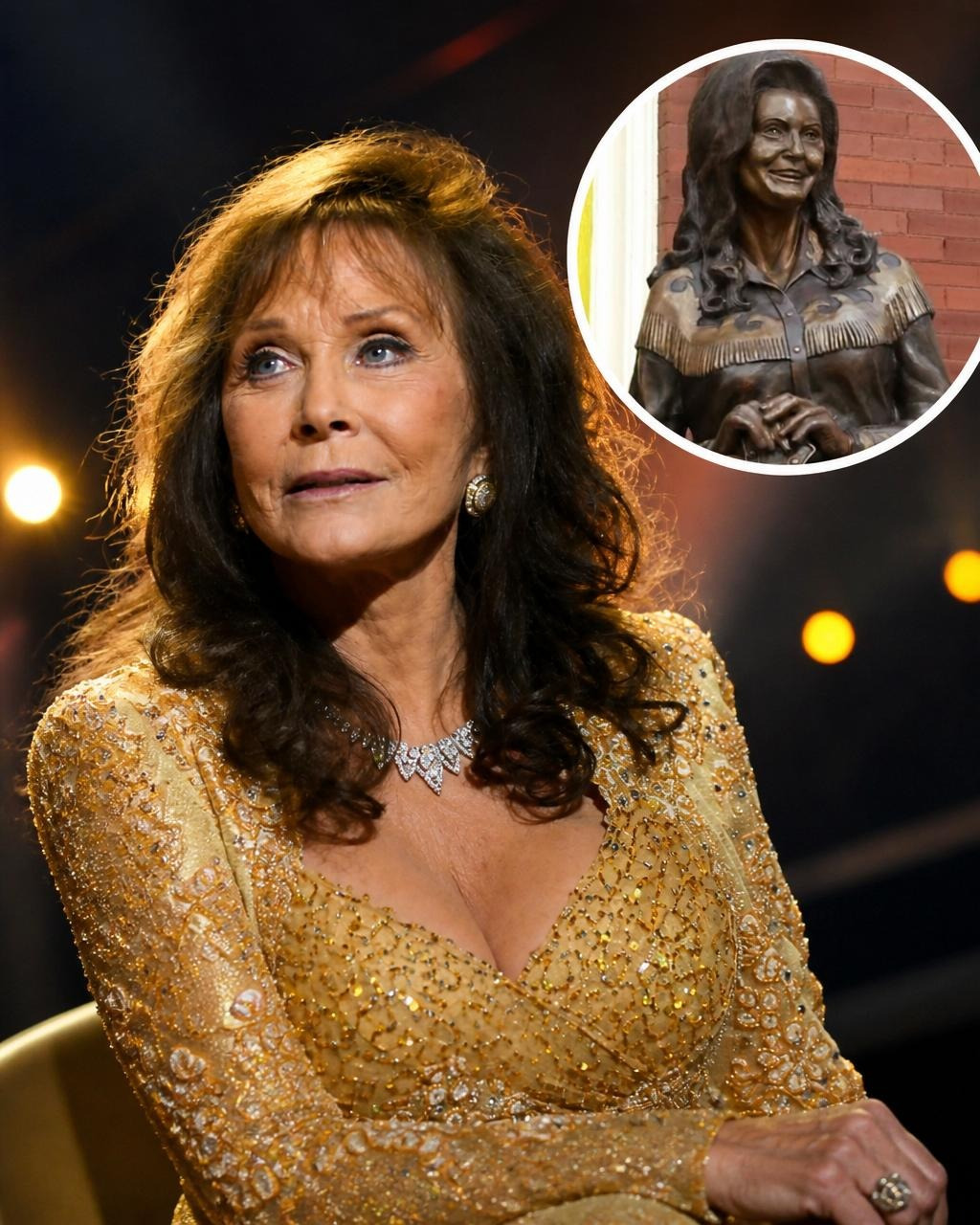
She Was 88 and Couldn’t Be There — But Her Two Daughters Revealed Her Bronze Statue at the Ryman

In 1960, Loretta Lynn and her husband Doolittle pulled up and parked right in front of the Ryman Auditorium with a simple dream and a whole lot of hope. Loretta had a No. 14 record called I’m A Honky Tonk Girl, and she wanted only one thing: a chance to sing on the Grand Ole Opry stage. At that point, even being near the Ryman felt like standing at the edge of something enormous.

She did not arrive with fame fully formed. She arrived with grit, determination, and a voice that would one day become part of country music history. That day in the parked car became one of those stories that lives on because it captures exactly who Loretta Lynn was — bold, patient, and willing to wait for the door to open.

A Full-Circle Moment at the Ryman

On October 20, 2020, that old dream returned in a new way. Loretta Lynn was 88 and could not be there in person, but her daughters, Patsy and Peggy, stood outside the Ryman Auditorium and pulled the cloth off a bronze statue of their mother on the Ryman’s Icon Walk.

The moment was quiet, emotional, and deeply personal. It was not just a tribute to a singer. It was a tribute to a woman whose story began with a parked car and a hope that seemed too big for one person to carry alone.

“It feels like I’ll get to stand at the Ryman for many more years to come.”

That message from Loretta captured the heart of the day. Even though she was not physically there, the honor carried her presence. Her daughters helped bring that moment home for her, turning memory into something permanent.

Crafted with Care

Sculptor Ben Watts spent a full year getting every detail right. The result is a bronze likeness that stands with dignity beside other country music legends, including Bill Monroe and Little Jimmy Dickens. It is the kind of tribute that does more than decorate a landmark. It tells a story about where country music has been and who helped shape it.

The statue is especially powerful because of where it stands. Right outside the Ryman, Loretta Lynn now remains connected forever to the place where she once sat in a car, waiting for someone to let her sing. That contrast makes the tribute even more moving. A dream that once felt far away now stands in bronze for everyone to see.

Why This Moment Still Matters

Loretta Lynn’s story has always been about perseverance, family, and staying true to herself. This unveiling honored all of that. It reminded fans that great careers often begin in humble places, and that the road from hope to history can be long, but worth every step.

For those who know Loretta Lynn’s journey, the statue at the Ryman is more than a piece of art. It is a symbol of country music’s living memory, and of a woman who never stopped being connected to her roots.

From that parked car in 1960 to the bronze statue in 2020, Loretta Lynn’s story came full circle in the most beautiful way.


You Missed

Charley Pride was once sold so his Negro League team could buy a used bus. Then Casey Stengel threw him out of Mets camp without watching him pitch. So he pulled a business card from his wallet and took a bus to Nashville instead — and became RCA’s best-selling artist not named Elvis Presley. In the Negro Leagues, Charley Pride and teammate Jesse Mitchell were sold to the Birmingham Black Barons, and the money helped their old club buy a used team bus. Pride later joked, “Jesse and I may have the distinction of being the only players in history traded for a used motor vehicle.” He kept chasing the major leagues anyway. Years later, Pride showed up uninvited at the New York Mets’ spring training camp in Florida. He had even shipped six bats ahead with his name engraved on them. Casey Stengel wanted no part of an unexpected tryout. “We ain’t running no damn tryout camp down here,” Stengel said. “Put him on a bus to anywhere he wants to go.” So Pride reached into his wallet. Inside was a business card from country singer Red Sovine, who had encouraged him to come to Nashville if he ever got serious about singing. Pride asked for a ticket to Tennessee. Within a few years, Chet Atkins helped bring him to RCA. Pride eventually scored 29 No. 1 country hits and became RCA’s best-selling artist not named Elvis Presley. His old Negro League teammate Otha Bailey remembered Pride sitting in the back of team buses picking a guitar with only two strings while the other players laughed. “But I think he knew where he was going.” Maybe he did. Because one man refusing to let Charley Pride throw a few pitches helped send him toward the place where he would change country music forever.

Tammy Wynette once said only one country singer could “hold a candle to George Jones” — and most people today barely remember his name. Vern Gosdin never had the fame of Jones, Haggard, Cash, or Strait. But among people who cared about pure country singing, his voice carried unusual weight. Wynette’s compliment said almost everything: she believed Gosdin was one of the very few singers who belonged in the same conversation as George Jones. What made his story even stranger was how close he came to leaving music behind completely. When his career stalled in the early 1970s, Gosdin moved to Georgia and went into the glass business. For a time, he was working with glass instead of records. Then he came back. “I Can Tell by the Way You Dance” reached No. 1. “Set ’Em Up Joe” became a classic. And “Chiseled in Stone,” written with Max D. Barnes, won the CMA Award for Song of the Year and became one of the recordings most closely associated with the nickname fans had given him: “The Voice.” But his final years were not easy. Gosdin suffered a stroke in 1998, yet continued writing and recording. In 2008, he released the 101-song box set *40 Years of the Voice*. He was even preparing a tour bus for more appearances before another stroke in 2009. Vern Gosdin died on April 28, 2009, at 74. The voice George Jones was so often compared against never became the biggest name in country music. But Tammy Wynette believed it belonged beside the greatest.