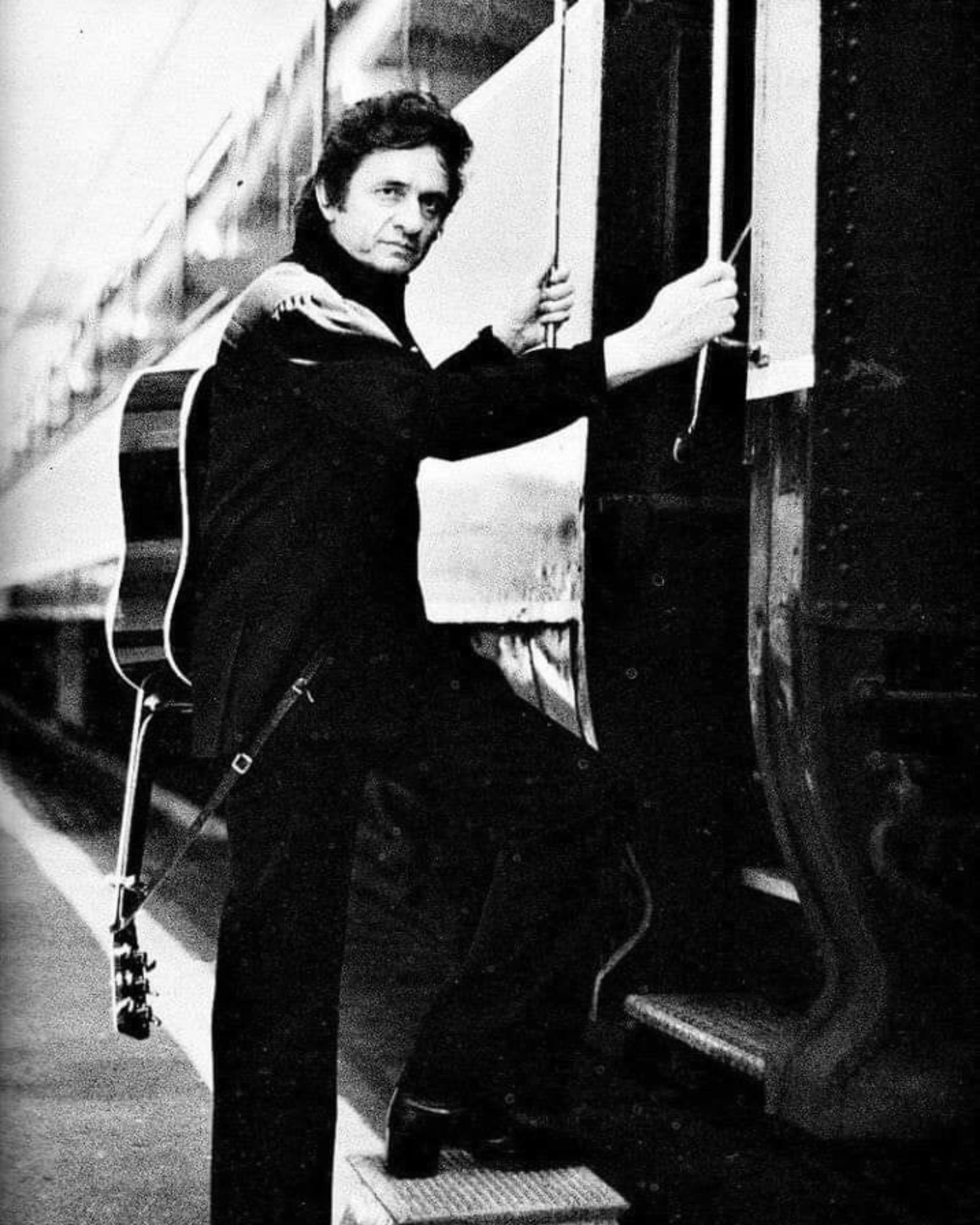
In 1955, Johnny Cash released a song about a man riding a train toward Tennessee, impatient to get home. Nearly fifty years later, the last song Johnny Cash ever wrote imagined another train carrying a coffin away.
The first was called “Hey Porter.” The last was “Like the 309.”
What makes the connection remarkable is that trains had been part of Johnny Cash’s life long before the world knew the name of the Man in Black. They were tied to childhood, family, hard times, and the sound that would eventually help make Johnny Cash famous.
The Railroad Tracks Outside Johnny Cash’s Childhood Home
Johnny Cash was born in Kingsland, Arkansas, in 1932, during the Great Depression. The Cash family lived near railroad tracks, and trains were part of the everyday landscape.
Johnny Cash’s father, Ray Cash, worked in agriculture. When there was no cotton to pick, Ray Cash sometimes rode freight trains in search of work.
One childhood memory stayed with Johnny Cash for decades.
As recounted in a Vanity Fair profile, Johnny Cash remembered watching Ray Cash jump from a moving boxcar, tumble down an embankment, and come to a stop near the family’s front door.
For a young boy, those trains weren’t simply machines passing through town. They were connected to the uncertainty of work and the familiar sight of a father coming home.
Years later, the rhythmic sound of moving trains would become closely associated with Johnny Cash’s music.
1955: The Train That Helped Launch a Career
After leaving the Air Force in 1954, Johnny Cash settled in Memphis, Tennessee, and began making music with guitarist Luther Perkins and bassist Marshall Grant.
The trio developed a spare, unmistakable sound built around a steady bass rhythm and simple electric guitar patterns. That driving rhythm would become known as Johnny Cash’s famous boom-chicka-boom sound.
Johnny Cash brought original songs to Sun Records, where producer Sam Phillips recognized something special in “Hey Porter.”
In a later interview with NPR’s Terry Gross, Johnny Cash recalled that Sam Phillips liked “Hey Porter” but wanted a love song or a sad romantic number to accompany it.
Johnny Cash returned with “Cry! Cry! Cry!”
The two recordings became Johnny Cash’s first Sun Records single in 1955.
“Hey Porter” follows an excited railroad passenger nearing Tennessee. The passenger keeps asking the porter about the remaining journey, eager to see familiar country again.
The song is full of anticipation. The destination matters because it means home.
For Johnny Cash, who had spent years away from the South during military service, that feeling was familiar.
Nearly Fifty Years Later, a Very Different Train
By 2003, Johnny Cash had lived an extraordinary musical life.
Johnny Cash had recorded countless songs, performed in prisons, crossed musical generations, and introduced country music to audiences far beyond Nashville.
But the final months were difficult.
June Carter Cash died on May 15, 2003. Johnny Cash continued working with producer Rick Rubin, recording whenever strength allowed.
The recording sessions provided a reason to keep making music during a painful period.
Among the songs Johnny Cash recorded was one final original composition: “Like the 309.”
Once again, the central image was a railroad train.
But this time, the passenger wasn’t asking how soon the train would arrive in Tennessee.
The passenger was imagining a coffin being loaded aboard.
In “Like the 309,” Johnny Cash pictures a final railroad journey, complete with a depot, a train whistle, and the practical details of being carried away.
Surprisingly, the song isn’t entirely sorrowful.
Johnny Cash approaches the subject with the dry humor that had always been part of Johnny Cash’s personality. The lyrics include ordinary, almost comical details alongside the unmistakable references to death.
Even in the final original song, Johnny Cash could find something wry to say about the end of life.
The Song Johnny Cash Never Lived to Hear Released
Johnny Cash died on September 12, 2003, at the age of 71.
“Like the 309” was not released during Johnny Cash’s lifetime.
Rick Rubin later completed the album American V: A Hundred Highways, using recordings from Johnny Cash’s final sessions. Additional instrumental work helped bring the project to completion.
The album arrived on July 4, 2006, almost three years after Johnny Cash’s death.
For listeners hearing “Like the 309” for the first time, the connection to “Hey Porter” gave the recording an extraordinary sense of closure.
It was not necessarily Johnny Cash’s final recorded performance, but it was the last song Johnny Cash wrote.
And it returned to one of the oldest images in Johnny Cash’s musical life.
Two Trains, One Extraordinary Life
In “Hey Porter,” Johnny Cash imagined a passenger watching for the signs of home.
In “Like the 309,” Johnny Cash imagined a passenger preparing to leave for good.
Between those two recordings lay nearly half a century of music, fame, family, hardship, and some of the most recognizable songs in American history.
There was also the memory of a boy in Arkansas, growing up beside railroad tracks and watching a father return from searching for work.
Johnny Cash wrote many songs about trains. But these two recordings occupy particularly meaningful places in the story.
The first belonged to the beginning of Johnny Cash’s recording career. The second became the final song Johnny Cash left behind as a songwriter.
One train was bringing someone home.
The other was taking someone away.
And both carried a little of the boy who had grown up listening to trains in Arkansas.