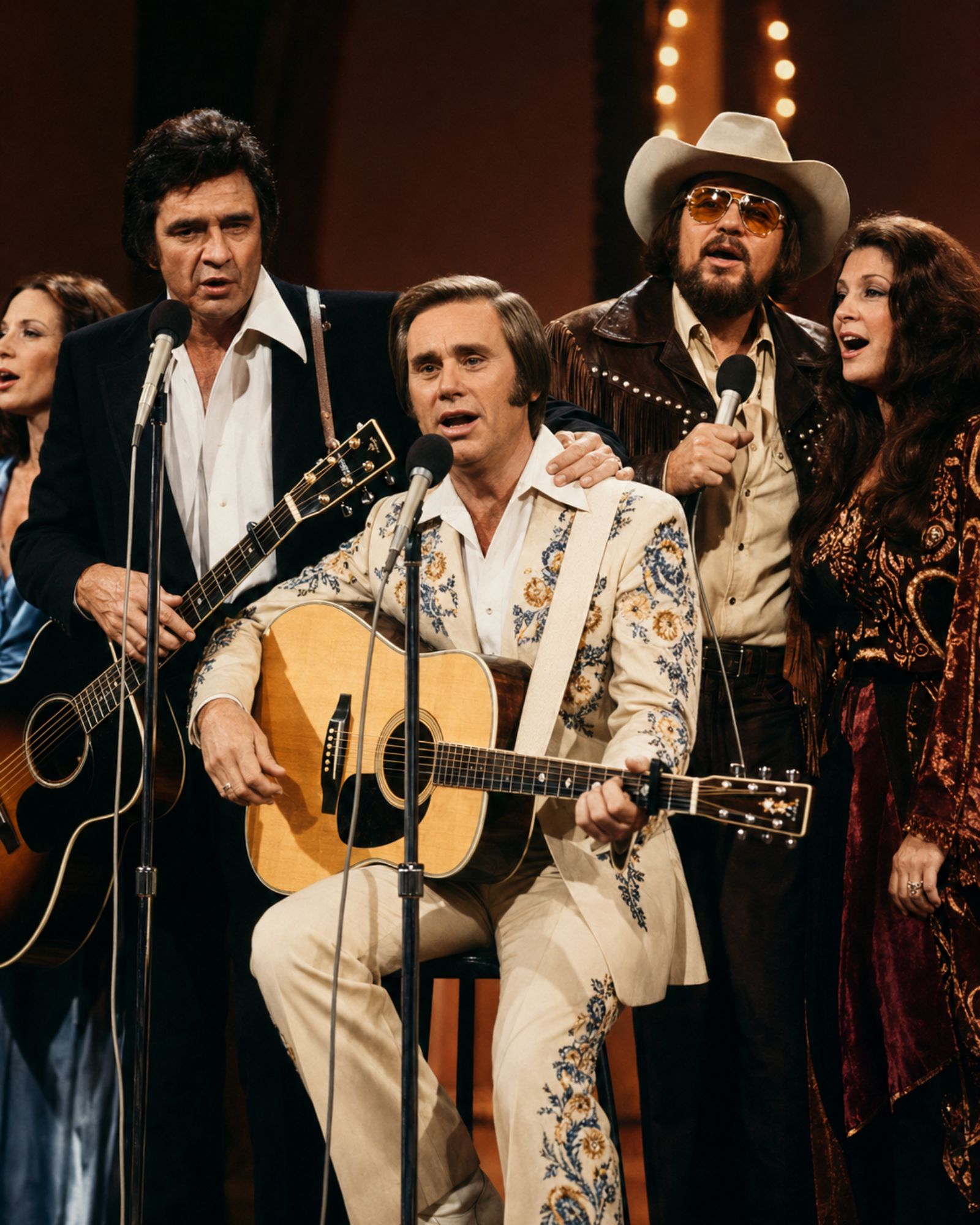
Merle, Waylon, and Cash Didn’t Agree on Much — But They All Knew What George Jones Was
George Jones was not just respected in country music. He was the singer other singers measured themselves against. In an era full of bold personalities and strong opinions, that kind of agreement meant something. Merle Haggard called him the greatest country singer of all time. Waylon Jennings put it another way: if every singer could sound the way he wanted, they would all sound like George Jones. Johnny Cash never hid his admiration either. Around men who had built their own legends, George Jones still made the room feel smaller.
That was the strange power of him. He was not the loudest man in the business, and he was not the most polished. He did not always arrive on time, and he did not always make life easy for the people around him. But once he stepped in front of a microphone, everything else seemed to disappear. The flaws, the stories, the chaos behind the scenes — all of it somehow turned into truth the moment he sang.
A Voice That Could Hold the Whole Room
Country music has never lacked for great voices, but George Jones had something different. His singing did not just carry a melody. It carried regret, longing, heartbreak, and a kind of honesty that could not be faked. Other singers could deliver the words. George Jones made people feel like they had lived them.
That is why so many musicians spoke about him with a mix of reverence and awe. They were not simply admiring technique. They were admiring the emotional weight he could bring to a song without seeming to force it. He could move from smooth to broken in a single line, and that shift made every lyric land harder.
George Jones made songs feel personal, even when millions of people were listening.
The Mess Behind the Music
George Jones was not a tidy legend. He drank. He disappeared. He broke promises, missed shows, and gave Nashville plenty of reasons to call him unreliable. His life could be chaotic, and at times it was painful to watch from the outside. Some careers are built on control. George Jones lived the opposite way for long stretches, and that made his survival feel almost impossible.
And yet, the music never stopped mattering. In some strange way, the wreckage became part of the art. When George Jones sang, listeners did not hear a man pretending to be broken. They heard someone who had been through it and returned with his voice still intact. That is not the same thing as polish. It is better than polish. It is earned.
Why “He Stopped Loving Her Today” Still Hurts
If one song defines the emotional force of George Jones, it is “He Stopped Loving Her Today.” Even now, it does not feel like a typical hit. It feels like a final confession, delivered with a calm that makes the ending hit even harder. The song is famous because it is heartbreaking, but it endures because George Jones sounds like he understands every word in a deeply personal way.
That performance is a reminder that technical perfection is not always what makes a singer unforgettable. George Jones had the rare ability to sound completely vulnerable without losing control of the song. He did not merely perform pain. He translated it.
What the Great Ones Saw in Him
Merle Haggard, Waylon Jennings, and Johnny Cash were not the type to hand out praise casually. Each man had his own style, his own standards, and his own idea of what country music should be. But George Jones crossed those lines. He impressed the skeptics. He humbled the proud. He made other great singers step back and admit that there was a level they could respect, even if they could never fully reach it.
That is why George Jones was feared by singers. Not because he threatened them in a bitter way, but because he represented the thing every serious vocalist hopes for: a voice so alive, so unmistakable, and so emotionally true that comparison becomes dangerous.
The Legend Was Never Just the Legend
Some artists are loved by fans. George Jones was loved, admired, and studied. He was the kind of singer whose best performances still feel fresh because they were never just about sounding good. They were about telling the truth in a way that could make a crowded room go quiet.
That is the legacy he left behind. Not perfection. Not discipline. Not even a clean story. George Jones left something harder to copy: a voice that made every other country singer measure themselves and wonder if they could ever be that honest.
Merle, Waylon, and Cash did not agree on much. But they all knew exactly what George Jones was. He was not just another star in country music. He was the standard.