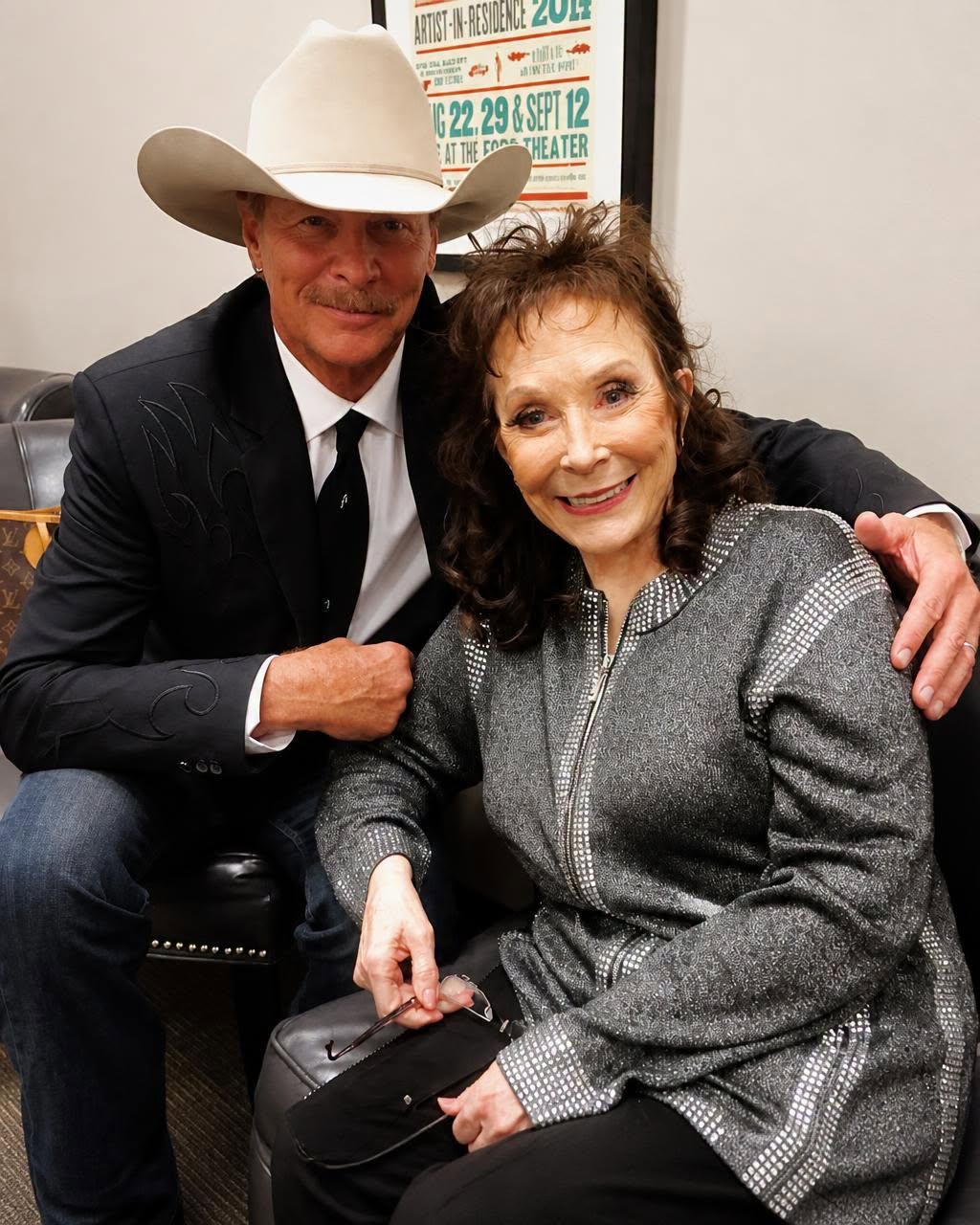
When Alan Jackson Honored Loretta Lynn Without Singing Her Songs

Twenty-six days after Loretta Lynn died, the Grand Ole Opry House felt like a room holding its breath. The tribute was not loud, not flashy, and not built around the biggest hits everyone expected. Instead, Alan Jackson chose something quieter and more personal: a song he had written for his own mother after she died.

Loretta Lynn died on October 4, 2022, at her home in Hurricane Mills, Tennessee, at the age of 90. Her family said she passed away peacefully in her sleep. For decades, she had done something rare in popular music: she wrote and sang about real life without softening it for comfort. Her songs told the truth about hard marriages, cheating husbands, poverty, motherhood, and the choices women made when they had almost no choices at all.

That honesty was part of her power. Loretta Lynn did not wait for permission to talk about private pain. She turned private pain into public music, and millions of listeners recognized themselves in it. At a time when some radio stations and gatekeepers wanted country music to stay polite and predictable, Loretta Lynn kept bringing life back into the room.

So when Alan Jackson stepped onto the Opry stage in late October 2022, he was not simply honoring a legend. He was answering her in the language she understood best: lived experience. He had asked Loretta Lynn’s family for permission to sing “Where Her Heart Has Always Been”, a song he had written for his own mother’s funeral. The choice carried weight because it came from the same place Loretta Lynn always sang from — memory, loss, and love that does not disappear just because a person is gone.

Some tributes are performed. Others are felt.

Alan Jackson did not need to imitate Loretta Lynn to honor her. He honored her by choosing a song rooted in family and grief, the kind of song that asks listeners to sit still and remember someone they loved. It was a fitting gesture for a singer who spent her life making room for the ordinary heartbreaks that shape people more than fame ever will.

Loretta Lynn’s legacy endures because she sang about the parts of life many people were told to hide. Alan Jackson’s tribute reminded everyone that the deepest honors are often the simplest ones. Twenty-six days after her death, the Opry stage became less a concert platform and more a place of farewell.

Which Loretta Lynn song still feels personal to you?


You Missed

In 1958, Ray Price was already one of country music’s biggest stars. Roger Miller was still trying to convince Nashville that he belonged there. Miller had already failed an audition for Chet Atkins, worked as a hotel bellhop, and spent time playing behind other singers. Then Ray Price hired him to join his Cherokee Cowboys. It put Miller inside one of the best country bands in the business — but the more important break came from a song he had written. Miller suggested that Price record “Invitation to the Blues.” Price did, releasing it as the B-side of his No. 1 hit “City Lights,” and “Invitation to the Blues” climbed to No. 3 on the country chart. It was Miller’s first major success in Nashville. Suddenly, other stars began paying attention to the young songwriter. Ernest Tubb recorded “Half a Mind.” Faron Young had success with “That’s the Way I Feel.” Jim Reeves took Miller’s “Billy Bayou” all the way to No. 1. Country fans were hearing Roger Miller’s words long before many of them knew Roger Miller’s voice. His own breakthrough took longer. Then came “Dang Me” in 1964, followed by “King of the Road” in 1965, and the struggling songwriter became one of country music’s most recognizable stars. Ray Price didn’t make Roger Miller famous. But years before the public understood what Roger Miller could do, one of country music’s biggest stars had already given him a place in the band — and listened when he brought him a song.

Charley Pride was once sold so his Negro League team could buy a used bus. Then Casey Stengel threw him out of Mets camp without watching him pitch. So he pulled a business card from his wallet and took a bus to Nashville instead — and became RCA’s best-selling artist not named Elvis Presley. In the Negro Leagues, Charley Pride and teammate Jesse Mitchell were sold to the Birmingham Black Barons, and the money helped their old club buy a used team bus. Pride later joked, “Jesse and I may have the distinction of being the only players in history traded for a used motor vehicle.” He kept chasing the major leagues anyway. Years later, Pride showed up uninvited at the New York Mets’ spring training camp in Florida. He had even shipped six bats ahead with his name engraved on them. Casey Stengel wanted no part of an unexpected tryout. “We ain’t running no damn tryout camp down here,” Stengel said. “Put him on a bus to anywhere he wants to go.” So Pride reached into his wallet. Inside was a business card from country singer Red Sovine, who had encouraged him to come to Nashville if he ever got serious about singing. Pride asked for a ticket to Tennessee. Within a few years, Chet Atkins helped bring him to RCA. Pride eventually scored 29 No. 1 country hits and became RCA’s best-selling artist not named Elvis Presley. His old Negro League teammate Otha Bailey remembered Pride sitting in the back of team buses picking a guitar with only two strings while the other players laughed. “But I think he knew where he was going.” Maybe he did. Because one man refusing to let Charley Pride throw a few pitches helped send him toward the place where he would change country music forever.