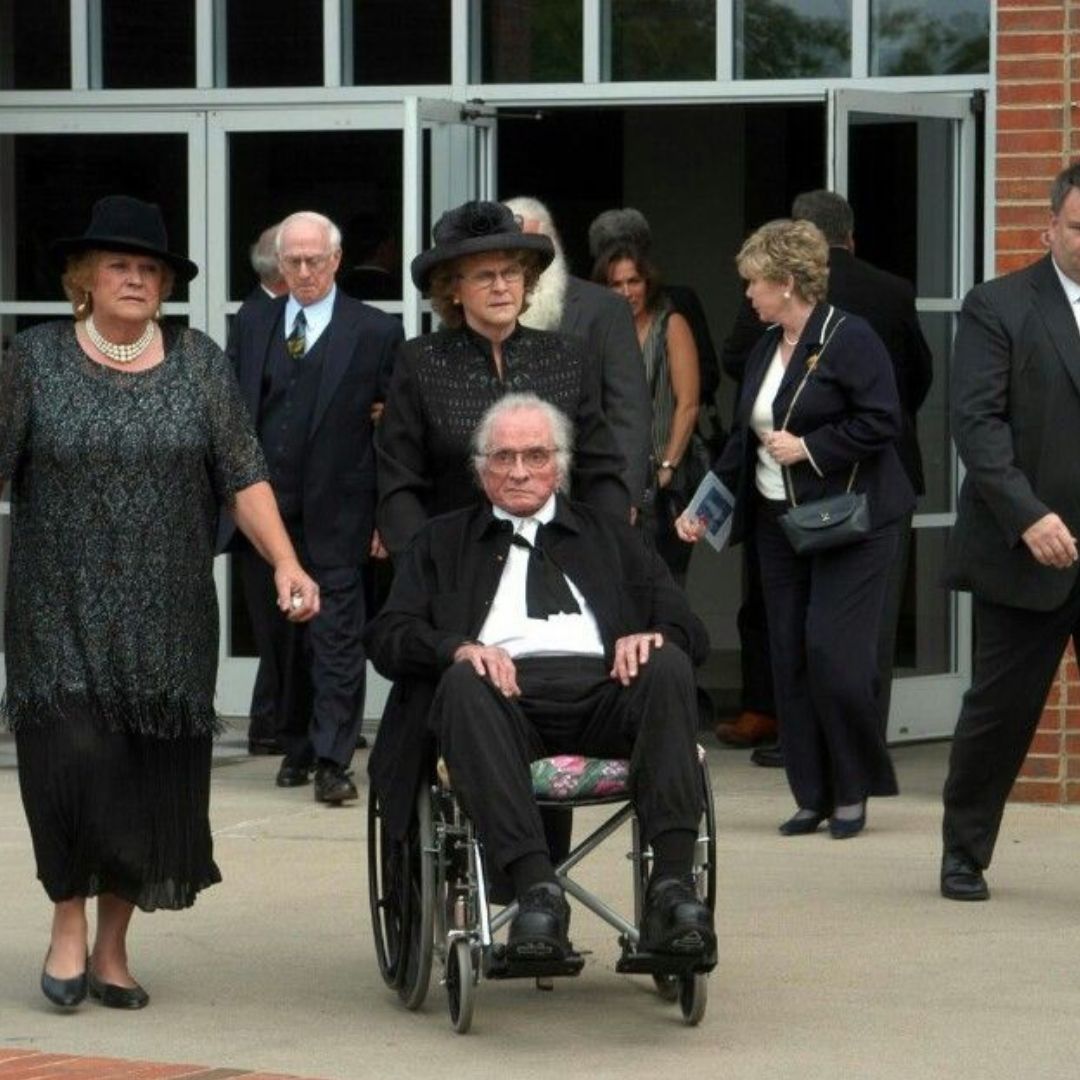
On September 15, 2003, more than 1,000 people gathered at First Baptist Church in Hendersonville, Tennessee, to say goodbye to Johnny Cash. Less than four months earlier, Johnny Cash had attended the funeral of June Carter Cash in that same church, sitting in a wheelchair as family and friends mourned the woman who had shared 35 years of marriage with the Man in Black.
Now Johnny Cash was gone, too. The legendary singer had died on September 12 at age 71, leaving behind five decades of recordings, unforgettable performances, and a family facing another devastating loss.
But the Hendersonville church held a history that went far beyond those final four months. And just before Johnny Cash died, Rosanne Cash had recorded a remarkable song with her father that would take on a deeper meaning after September arrived.
The Church Where June Once Brought Johnny
Long before the two funerals, First Baptist Church had played a meaningful role in the lives of Johnny Cash and June Carter Cash.
At June Carter Cash’s funeral on May 18, 2003, former pastor Courtney Wilson recalled meeting the couple approximately 36 years earlier. Johnny Cash was going through a difficult period, and June Carter Cash encouraged Johnny Cash to attend church.
Johnny Cash was reluctant to return to public life so soon. June Carter Cash suggested arriving late and sitting in the back.
They attended, and Courtney Wilson delivered a sermon about the living water of Christ. The message stayed with Johnny Cash, who later remembered the occasion in a book.
That history made the events of 2003 particularly meaningful. The congregation that had welcomed the couple decades earlier would eventually witness the family’s two most difficult farewells.
The Song Rosanne Cash Never Planned to Record With Her Father
In March 2003, Rosanne Cash released the album Rules of Travel. Among its recordings was a duet with Johnny Cash titled September When It Comes.
The song explored aging, the passage of time, and the difficult realization that parents will not always be there.
In a June 23, 2003, interview with Terry Gross on NPR’s Fresh Air, Rosanne Cash explained that the song had been indirectly inspired by Johnny Cash’s earlier health struggles and the realization of a parent’s mortality.
Yet Rosanne Cash had not originally intended to record it with Johnny Cash. Rosanne Cash had already recorded a solo version.
Producer and husband John Leventhal believed the song needed Johnny Cash’s voice. Rosanne Cash initially resisted, worried that inviting her famous father might make listeners see the recording as a novelty rather than appreciate the song itself.
John Leventhal continued encouraging Rosanne Cash until Rosanne Cash finally agreed to ask.
Johnny Cash did not immediately agree to sing. Johnny Cash first wanted to read the lyrics, making sure the words were authentic to what Johnny Cash believed.
After reading them, Johnny Cash accepted.
The recording took place in Johnny Cash’s small studio cabin in the woods near the family home. Rosanne Cash later remembered the session as a particularly sweet day, with Rosanne Cash, Johnny Cash, and Rosanne Cash’s brother working together.
Johnny Cash subsequently told Rosanne Cash that Johnny Cash was proud of the recording within the context of the entire album.
For Rosanne Cash, that approval meant a great deal. The duet had become more than a collaboration between two respected musicians. It was a conversation between a father and daughter about time, change, and accepting life’s limits.
September 15, 2003: Nashville Says Goodbye
When mourners assembled at First Baptist Church, some of country music’s best-known figures were among them: Kris Kristofferson, George Jones, Hank Williams Jr., Vince Gill, Dwight Yoakam, and Marty Stuart.
Johnny Cash’s casket was decorated with a wreath incorporating flowers and plants, including cotton, figs, and potatoes. The rural details recalled the Arkansas fields where Johnny Cash had worked during childhood.
Kris Kristofferson offered a prayer. Emmylou Harris and Sheryl Crow performed “The Old Rugged Cross” and Bob Dylan’s “Every Grain of Sand.” Larry Gatlin later led the congregation in “Oh Come, Angel Band.”
A video montage brought Johnny Cash’s familiar baritone back into the church. The film included scenes from earlier performances and reminded mourners of the extraordinary career that had begun long before worldwide fame arrived.
Rosanne Cash’s Most Personal Goodbye
During the service, Rosanne Cash spoke about the difference between the public’s loss and the family’s loss.
Many people had told Rosanne Cash that they could not imagine a world without Johnny Cash. Rosanne Cash understood that Johnny Cash’s recordings would remain available to generations of listeners.
“I cannot begin to imagine a world without Daddy.”
Those words carried an especially poignant meaning because September When It Comes had already been released months earlier.
The duet was not written as a funeral tribute. It had been created while Johnny Cash was still alive, when father and daughter could share the experience of making music together.
Johnny Cash was buried beside June Carter Cash at Hendersonville Memory Gardens.
Today, recordings such as “I Walk the Line,” “Ring of Fire,” and “Hurt” continue to introduce new audiences to the Man in Black. But September When It Comes preserves something different: the sound of Johnny Cash and Rosanne Cash confronting the passage of time together.
For the public, September 2003 marked the loss of an American music legend. For Rosanne Cash, it meant saying goodbye to Daddy.