Hank Williams, the Blue Cadillac, and the Song That Turned Into a Warning
By the end of 1952, Hank Williams was only 29 years old, but he already sounded like a man who had lived several hard lifetimes. Fame had come fast. So had heartbreak, pain, exhaustion, and the kind of nightly pressure that can hollow a person out even while the crowd is still cheering. On records, Hank Williams could make sorrow sound simple. Offstage, nothing about his life was simple anymore.
That is what makes the story of “I’ll Never Get Out of This World Alive” feel so eerie all these years later. Hank Williams recorded the song in 1952, and it carried the dry, crooked humor that ran through so much of his best work. The title sounded playful on the surface, almost like a wink from a man who understood how absurd life could be. But in retrospect, it feels less like a joke and more like the kind of line only Hank Williams could write without realizing how close it was to the truth.
A Star Moving Too Fast
By then, Hank Williams was not just successful. Hank Williams was one of the brightest stars in country music. Songs like “Cold, Cold Heart,” “Hey, Good Lookin’,” and “Jambalaya” had already made Hank Williams larger than life. But success did not protect Hank Williams from physical pain or emotional collapse. Years of back trouble, relentless travel, alcohol, and pills were taking a visible toll.
Still, the machine kept moving. There were shows to play, tickets to sell, crowds waiting in winter weather for the voice they believed could carry them through their own loneliness. On New Year’s Day 1953, Hank Williams was supposed to appear in Canton, Ohio. He never made it.
The Ride North
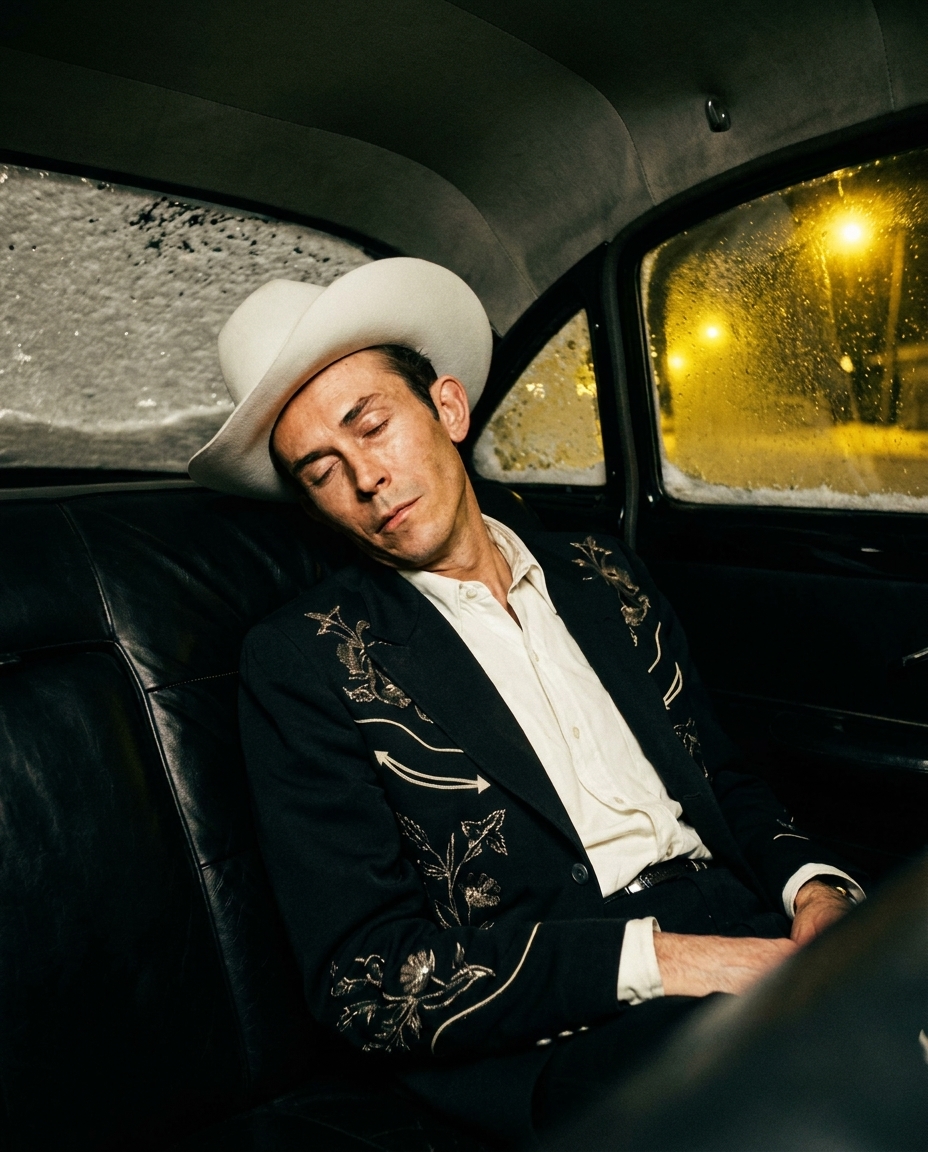
Because bad weather had disrupted travel, Hank Williams hired a young driver, Charles Carr, to take him north in a powder-blue Cadillac. It is one of those details that has stayed frozen in American music history: the blue car, the winter roads, the singer in the back seat, wrapped in an overcoat and blanket, drifting in and out while the miles slipped by in darkness.
Hank Williams was already in poor shape. Along the way, a doctor was called to see him. The combination already in his body was dangerous, and the night did not improve it. Somewhere between stops, with the road stretching ahead toward another stage, Hank Williams fell silent.
That is the terrible power of the image. Not a grand finale under lights. Not a final bow. Just a tired young man in the back seat of a Cadillac, famous across America, alone with his pain while the world still expected him to arrive smiling and ready to sing.
When Charles Carr Turned Around
Near Oak Hill, West Virginia, Charles Carr eventually looked back. At first, Hank Williams may have seemed asleep. That would have been the kinder thought. But when Charles Carr noticed the stillness, the coldness, and the way Hank Williams no longer responded, the truth began to settle in. The body in the back seat was not resting. Hank Williams was gone.
It is easy to romanticize a death like that because the story feels almost too perfect in its sadness. A songwriter records a song about never getting out of this world alive, and within weeks he is dead before age 30, traveling to one more show he would never play. But the reality was not poetic. It was brutal, lonely, and final.
Hank Williams did not die as a legend that night. Hank Williams died as a young man whose body had simply taken too much for too long.
The Show Without Hank Williams
Back in Canton, the audience had gathered expecting Hank Williams. Instead, they received the news that their headliner would not appear. For a moment, some reportedly thought it had to be a misunderstanding, maybe even a cruel joke. Then the mood changed. The band began “I Saw the Light,” and suddenly the room understood that country music had lost the voice that had given it a new kind of honesty.
That is why this story still lingers. Not only because Hank Williams died young, and not only because the song title now sounds prophetic. It stays with people because it captures the frightening gap between public image and private collapse. America saw Hank Williams as unstoppable. The truth was that Hank Williams had been breaking for a long time.
So was Hank Williams running toward the next paycheck, the next crowd, the next obligation? Or was Hank Williams trying to outrun the pain, the failures, the fear that silence might catch him if the road ever stopped? No one can answer that completely now. But the blue Cadillac still feels like more than a car in this story. It feels like the last lonely stretch between a man and the legend he became.