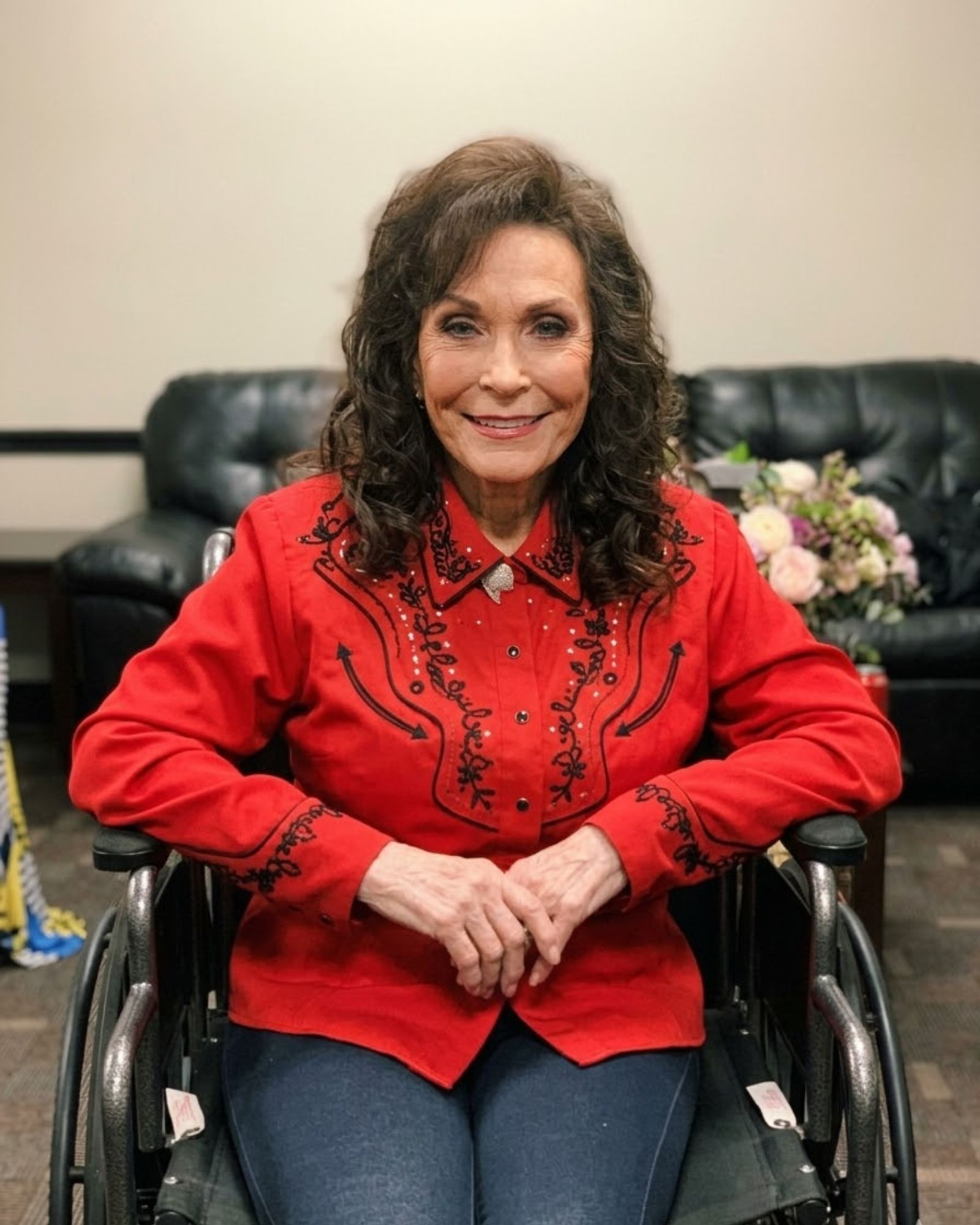
Loretta Lynn Turned Pain Into One More Record
There are some comebacks that feel loud. This was not one of them.
Loretta Lynn’s return felt slower, heavier, and far more human than that. It did not arrive with fireworks or a carefully polished headline. It arrived after fear. After weakness. After the kind of setbacks that make people quietly assume the story is finished.
In May 2017, Loretta Lynn suffered a stroke at home in Hurricane Mills, Tennessee. The damage affected the left side of Loretta Lynn’s body. Suddenly, the everyday things that once felt natural no longer came easily. Walking became uncertain. Singing became a question. The future, which had always seemed wide open through sheer willpower, narrowed into doctor visits, recovery routines, and long stretches of waiting.
Then, just as Loretta Lynn was still fighting to regain strength, another blow came. About eight months later, Loretta Lynn fell and broke a hip. For most people, that would have been more than enough to end any thought of stepping back into a studio. For an artist in the later chapters of a long life, many outsiders likely assumed the answer was obvious.
It was over.
That is usually how people talk when they are watching from a distance. They look at the age, the injuries, the obstacles, and decide the ending for someone else. But Loretta Lynn had never built a life around what other people thought was realistic.
“Your mind tells you, ‘You can!’ but your body soon tells you, ‘No you can’t quite do this.’”
That quote says almost everything. It is honest. There is no fake toughness in it. No pretending pain did not matter. Loretta Lynn understood the gap between desire and ability. Loretta Lynn knew exactly what the body was refusing to do. And still, that was not the end of the story.
Back to the Studio at 88
At 88 years old, Loretta Lynn went into Cash Cabin Studio and recorded what became the 50th album of Loretta Lynn’s career. That number alone carries weight. Fifty albums is not just a milestone. It is a map of a lifetime. It is proof of endurance, reinvention, heartbreak, memory, and work.
But what made this moment remarkable was not only the number. It was the condition Loretta Lynn arrived in. This was not the version of Loretta Lynn that audiences remembered from the brightest years on stage. This was an artist who had been tested by time in the most physical way possible. An artist who could no longer rely on the same control, stamina, or rhythm. An artist who had to find a new path to the same truth.
And that is exactly what happened.
Instead of trying to sound untouched, Loretta Lynn leaned into what remained. The voice carried age. The phrasing carried weariness. The pauses carried history. Rather than hide the struggle, the music seemed to make room for it. That choice gave the songs something deeper than polish. It gave them gravity.
When the Words Had to Carry More
The album included 13 tracks and reached backward even as it moved forward. Loretta Lynn re-recorded the first single from 1960, creating a conversation between the young woman who began the journey and the legend who had survived it. Reba McEntire, Carrie Underwood, and Tanya Tucker joined the project, bringing warmth and recognition to a record that already felt rich with meaning.
One of the most moving choices was “Coal Miner’s Daughter.” Loretta Lynn did not approach it like a familiar performance to be recreated exactly as before. Loretta Lynn spoke it more like a reflection, almost like a prayer. That decision changed everything. The song no longer sounded like a memory told with youthful spark. It sounded like a woman standing inside her own life story, touching every hard year and every miracle with bare hands.
Loretta Lynn could not keep the beat the same way anymore. But maybe that was never the point. When the body could not do what it once did, the words stepped forward and carried the emotion. The limitations did not weaken the songs. In a strange and beautiful way, they made the songs feel stronger, because nothing about them was pretending.
A Different Kind of Strength
There is something unforgettable about an artist who refuses to disappear quietly. Not because the artist is chasing relevance, but because the artist still has something real to say. That is what makes this chapter of Loretta Lynn’s life so moving. It was not about proving perfection. It was about showing up, wounded and changed, and creating anyway.
Many people measure strength by how untouched a person looks after hardship. Loretta Lynn offered another definition. Strength can look unsteady. Strength can need help getting through the door. Strength can sound cracked, slower, and different than before. It can still be strength.
After a stroke. After a broken hip. After every reason to stop, Loretta Lynn made another album. Not because it was easy. Because it mattered.