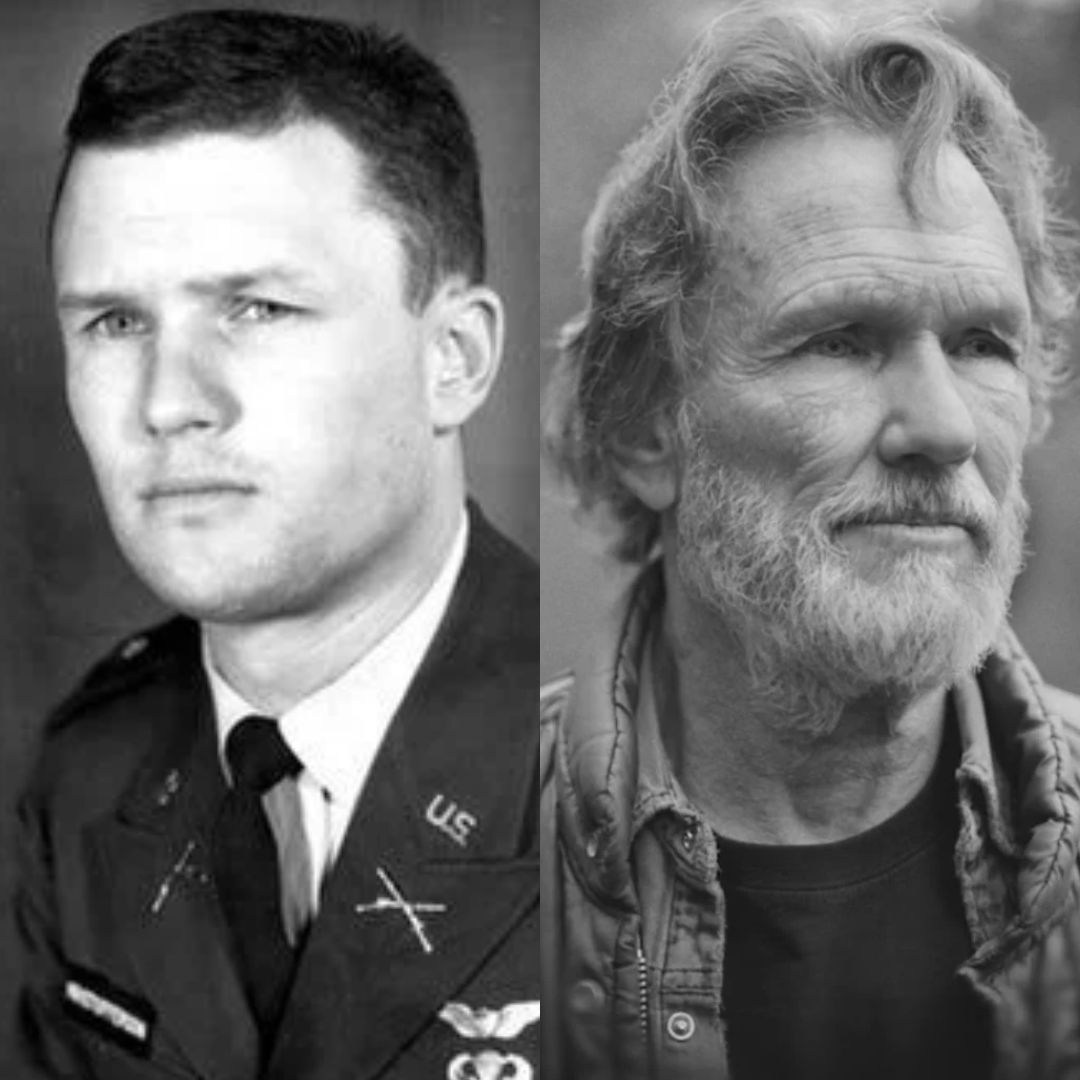
Two weeks before Kris Kristofferson was supposed to begin teaching English literature at West Point, Kris Kristofferson walked away from a military career that seemed destined for success.
Kris Kristofferson had been a Rhodes Scholar at Oxford University, earned the rank of captain in the U.S. Army, and trained as a helicopter pilot. For a young man raised in a military family, the future appeared settled.
But Kris Kristofferson wanted something different. Kris Kristofferson wanted to write songs.
That decision would cost Kris Kristofferson far more than a steady paycheck. It would also lead to an unlikely friendship with Johnny Cash, a famous helicopter landing, and one of country music’s most unforgettable songs.
From West Point to a Nashville Recording Studio
In 1965, Kris Kristofferson left the military and pursued songwriting in Nashville. The decision deeply upset the family. Kris Kristofferson later acknowledged that the choice contributed to the breakdown of the first marriage and caused a painful separation from the parents.
Success did not arrive quickly.
To make ends meet, Kris Kristofferson took various jobs, including working as a janitor and studio assistant at Columbia Recording Studios.
The responsibilities were ordinary: emptying ashtrays, supplying recording tape, cleaning floors, and preparing rooms for musicians.
But the surroundings were extraordinary.
During the recording of Blonde on Blonde, Kris Kristofferson watched Bob Dylan working in the studio. Kris Kristofferson later remembered seeing Bob Dylan sitting alone at a piano, developing songs while musicians waited nearby.
For an aspiring songwriter, the job provided a remarkable opportunity to observe the creative process.
And Columbia Studios brought Kris Kristofferson into the orbit of Johnny Cash.
The Helicopter Landing That Became Country Music Legend
Kris Kristofferson admired Johnny Cash and repeatedly tried to get original songs heard. Demo tapes were passed along through June Carter and guitarist Luther Perkins, but the hoped-for breakthrough remained elusive.
Then came the incident that country music fans would discuss for decades.
Kris Kristofferson landed a National Guard helicopter at Johnny Cash’s home near Old Hickory Lake.
The popular version describes Kris Kristofferson stepping out with a beer and a demo tape, presenting Johnny Cash with “Sunday Mornin’ Comin’ Down.”
But the story becomes much more interesting when the two musicians’ recollections are compared.
What Kris Kristofferson Said Really Happened
Kris Kristofferson confirmed that the helicopter landing actually occurred. But Kris Kristofferson disputed several familiar details.
According to Kris Kristofferson, Johnny Cash was not even home when the helicopter landed.
Kris Kristofferson also rejected the image of arriving with a beer in hand, explaining that controlling the helicopter required both hands and both feet.
Most surprisingly, Kris Kristofferson maintained that the tape delivered that day was not “Sunday Mornin’ Comin’ Down.”
Johnny Cash remembered the event differently, and Kris Kristofferson was generally happy to let the famous story live on.
Despite the conflicting memories, the friendship was real. Johnny Cash encouraged Kris Kristofferson during years when getting songs recorded remained difficult.
The Song That Finally Changed Everything
Ray Stevens recorded “Sunday Mornin’ Comin’ Down” in 1969, before Johnny Cash turned the song into a major country hit in 1970.
Johnny Cash’s recording reached No. 1 on the Billboard country chart, and the composition earned the Country Music Association’s Song of the Year award.
Yet another remarkable moment happened during a performance for The Johnny Cash Show.
Network representatives wanted Johnny Cash to replace the word “stoned” with “home” in one of the song’s most important lines.
Kris Kristofferson remembered watching from the balcony at Nashville’s Ryman Auditorium, uncertain what Johnny Cash would do.
When the moment arrived, Johnny Cash sang the original word.
For Kris Kristofferson, that decision mattered. It meant the song could be heard as written, without softening the loneliness and honesty at its center.
More Than a Helicopter Story
Kris Kristofferson went on to write classics including “Me and Bobby McGee,” “Help Me Make It Through the Night,” and “For the Good Times.”
The songwriting success eventually led to a celebrated recording and acting career, along with a place among country music’s most respected figures.
But the early Nashville years reveal something easily overlooked in the familiar legend.
Kris Kristofferson did not become successful because of one spectacular helicopter landing. The breakthrough came after years of writing, struggling, meeting musicians, and finding people willing to listen.
The former Army captain who once cleaned Columbia’s recording rooms eventually became one of the songwriters whose music those same studios would help bring to the world.
And long after the helicopter story became legendary, it was Johnny Cash’s decision to sing a song exactly as Kris Kristofferson wrote it that remained one of the most meaningful moments in their musical friendship.