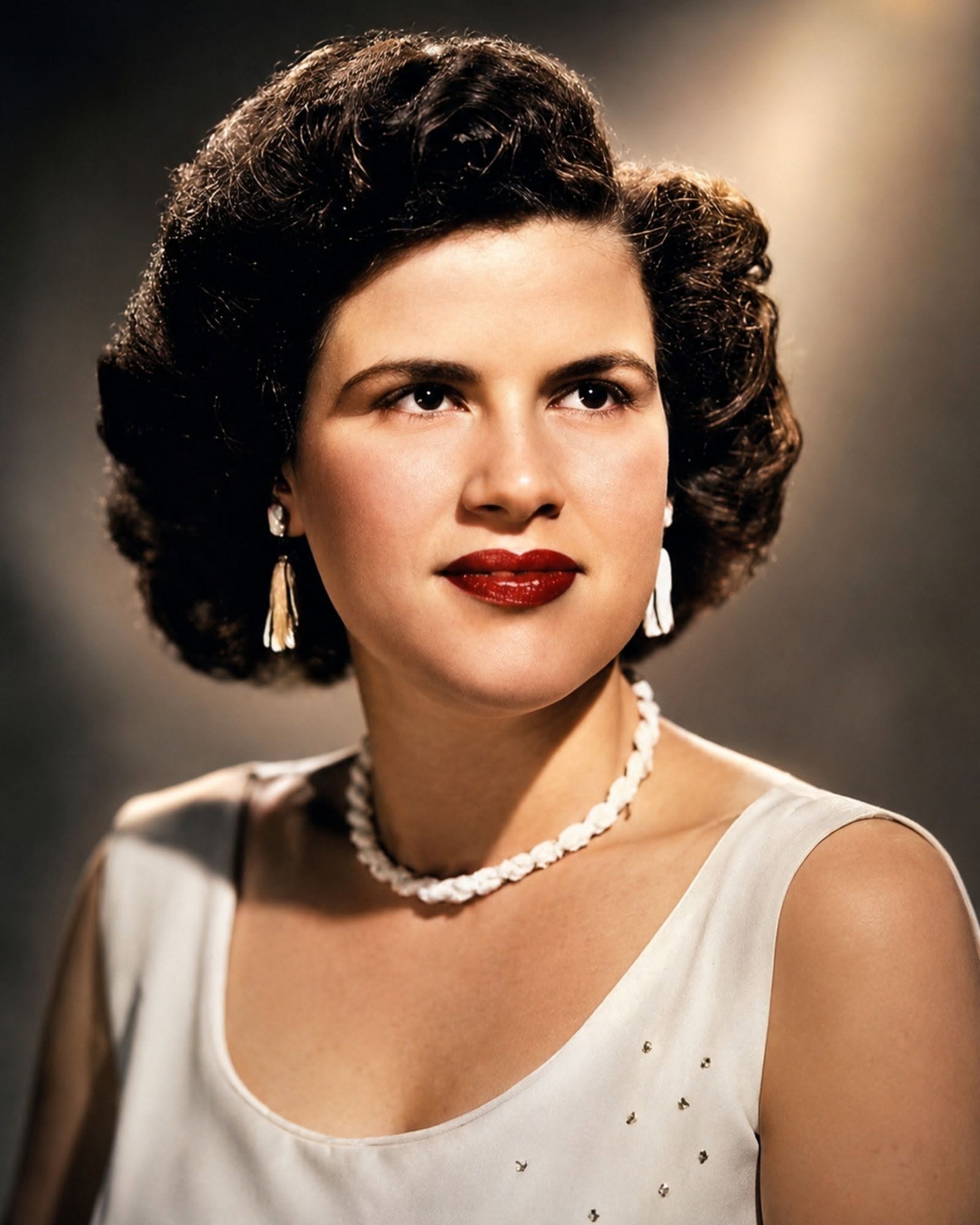
They Held Her Funeral in Winchester, Virginia: The Goodbye the Whole Country Came to See
On the day Patsy Cline was laid to rest in Winchester, Virginia, the town changed in a way few people there had ever seen. Streets that usually belonged to neighbors, shopkeepers, and familiar routines were filled with grief, flowers, and silence. More than 25,000 people lined the roads to say goodbye to a woman who was only 30 years old when her life ended far too soon.
Before her body came home, Nashville held a prayer service of its own. The city could not wait. Friends, fellow musicians, and fans gathered in sorrow, trying to make sense of a loss that felt larger than one singer, larger than one family, larger than country music itself. Patsy Cline had become more than a performer. She had become a voice people trusted with heartbreak.
A Girl Named Ginny Hensley
Long before the fame, before the records, before the endless airplay, Patsy Cline was Ginny Hensley, a girl from Winchester who sang anywhere people would listen. She sang for spare change, not because it was a charming beginning for a legend, but because her family needed help putting food on the table. That early struggle stayed with her. It gave her songs a weight that audiences could feel immediately.
Her rise was not simple, and it was not quick. She worked, she waited, and she kept singing. When success finally came, it came with the kind of force that changes the shape of music history. Three studio albums was all she recorded, yet those few records carried a sound so strong and so unmistakable that they outlived the years of her short life.
The Voice That Changed Country Music
Patsy Cline did not just sing songs. She made them feel permanent. Her version of Crazy, written by a then-unknown Willie Nelson, became the No. 1 jukebox song of all time. That fact alone says something about her reach. Her voice moved beyond radio charts and into everyday life. People heard her in diners, bars, dance halls, and family kitchens. They heard her when they were in love, when they were grieving, and when they had no words of their own.
She became the kind of artist whose recordings never really disappear. They keep finding new listeners, new generations, and new reasons to matter. Even now, her catalog continues to sell, and her influence remains part of the foundation of country music.
Some singers are remembered. Patsy Cline was never just remembered. She was carried forward.
The Shock of Losing Her So Young
Her death left behind two children, a newly moved-into dream house, and a future that had barely begun to unfold. There is something especially painful about a life interrupted at the exact moment it seemed ready to open wider. The music world did not just lose a star. It lost what might have come next.
Loretta Lynn, one of Patsy Cline’s closest friends, never recovered from the loss. That grief echoed through country music for decades. When artists later spoke about the women who made them believe they belonged in the genre, Patsy Cline’s name came up again and again. K.d. lang, Linda Ronstadt, Trisha Yearwood, Wynonna, and many others all pointed back to the same voice. She was proof that country music could hold depth, elegance, sorrow, and strength all at once.
Winchester Said Goodbye
When her remains were returned to Winchester, the town became a place of pilgrimage. News media arrived. Fans arrived. People who had never met her stood shoulder to shoulder with those who had known her since childhood. The funeral was not only a private goodbye. It was a public acknowledgment that something rare had been lost.
Winchester had watched a local girl rise into a national treasure, and now it watched her come home one last time. The crowd along the streets was a final tribute to the journey from humble beginnings to lasting legend. It was also a reminder that greatness sometimes begins in the smallest places.
A Legacy That Still Stands
In 1973, the Country Music Hall of Fame inducted Patsy Cline, making her the first solo woman ever to receive that honor. The recognition came a full decade after her death, but it only confirmed what fans already knew. Her influence was not fading. It was growing.
Country music spent sixty years trying to find another Patsy Cline. It never did. That is not a failure of the genre. It is proof of how singular she was. Her voice carried a kind of honesty that still feels fresh, still feels personal, still feels close enough to touch.
More than anything, Patsy Cline left behind a standard. She showed that a singer from a small town could change the emotional language of an entire genre. And when Winchester lined its streets with 25,000 people, the message was clear: this was not just the funeral of a famous woman. It was the farewell to one of country music’s greatest truths.