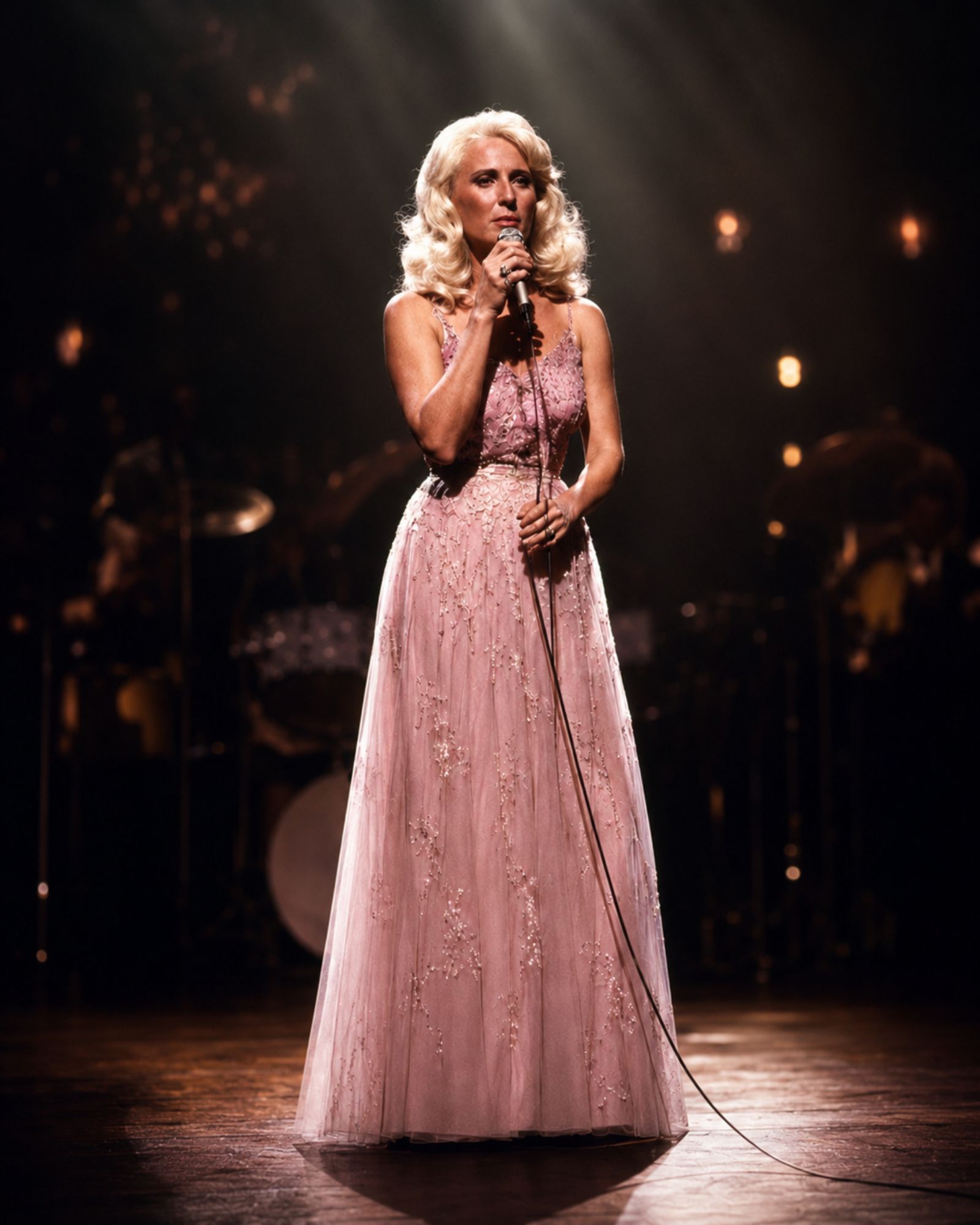
She Said a Man With a Gun Was Waiting in the Back Seat. Days Later, Tammy Wynette Still Walked Onstage in South Carolina
By 1978, Tammy Wynette already knew how to turn heartbreak into music. She had built a career on songs that sounded like they were pulled straight from kitchen tables, divorce papers, and late-night arguments. “Stand by Your Man,” “D-I-V-O-R-C-E,” and “I Don’t Wanna Play House” made her one of country music’s most recognizable voices, and they also made her a symbol of endurance. People did not just hear Tammy Wynette sing; they heard a woman who had lived through enough pain to recognize it in every note.
But the story surrounding Tammy Wynette was never only about what happened onstage. Her personal life had become public property in ways that were often unfair and exhausting. There were marriages, separations, health worries, and headlines that seemed to follow her no matter where she turned. By the late 1970s, she carried the weight of fame and private struggle at the same time, and that combination can wear a person down more than most audiences ever realize.
Then came October 4, 1978.
Tammy Wynette had gone shopping in Green Hills, Tennessee, to buy a birthday gift for her daughter. It was a simple errand, the kind of everyday task that should have ended with a wrapped present and a quiet drive home. Instead, she later said that when she returned to her car, a masked man was waiting in the back seat with a gun.
What followed was terrifying. According to the account she gave, the man forced her to drive, assaulted her, and eventually left her about 80 miles away in Giles County. The attack shocked fans and created a cloud of fear and confusion that never fully lifted. No one was ever convicted, and the unanswered questions became part of the tragedy. For Tammy Wynette, the incident was not a headline. It was a violent break in the middle of her life.
And yet, days later, she still had to perform.
That detail is what continues to strike people decades later. Tammy Wynette did not have the luxury of disappearing into safety and silence. She had a schedule, a band, a stage, and fans who had bought tickets expecting to see the woman they called the First Lady of Country Music. In Columbia, South Carolina, she stepped out under the lights and sang.
It is easy to imagine the scene from the audience’s point of view. The crowd may have seen the polished hair, the familiar smile, and the gown catching the light. They may have heard the voice that had soundtracked their own marriages, breakups, and lonely drives. What they could not fully know was that the woman singing for them was still carrying the aftermath of something awful, something that had not been solved or softened by time.
Some performers can leave their pain backstage. Tammy Wynette was never that simple. Her life and her songs were too closely tied together, and that made every performance feel personal.
That is part of why Tammy Wynette remains such a compelling figure in country music history. She was not untouchable. She was not made of image alone. She was vulnerable, complicated, and often forced to keep going even when her life was hurting in public. Her strength did not come from pretending nothing had happened. It came from showing up anyway.
The South Carolina concert became more than a date on a tour schedule. It became a reminder of how much pressure artists can face when their lives are already falling apart behind the scenes. For Tammy Wynette, walking onstage after that attack was not about ignoring fear. It was about surviving it in front of everyone.
Years later, people still talk about Tammy Wynette for the songs, the tears, and the mythology of country music. But the darker, quieter parts of her story matter too. They reveal a woman who kept working through uncertainty, who carried bruises and unanswered questions, and who still stood in the spotlight because that was what her life required.
That night in Columbia, South Carolina, the audience came to hear Tammy Wynette sing. What they witnessed was something more complicated: a performer reclaiming her place in the world, one song at a time, even after the world had done its worst.