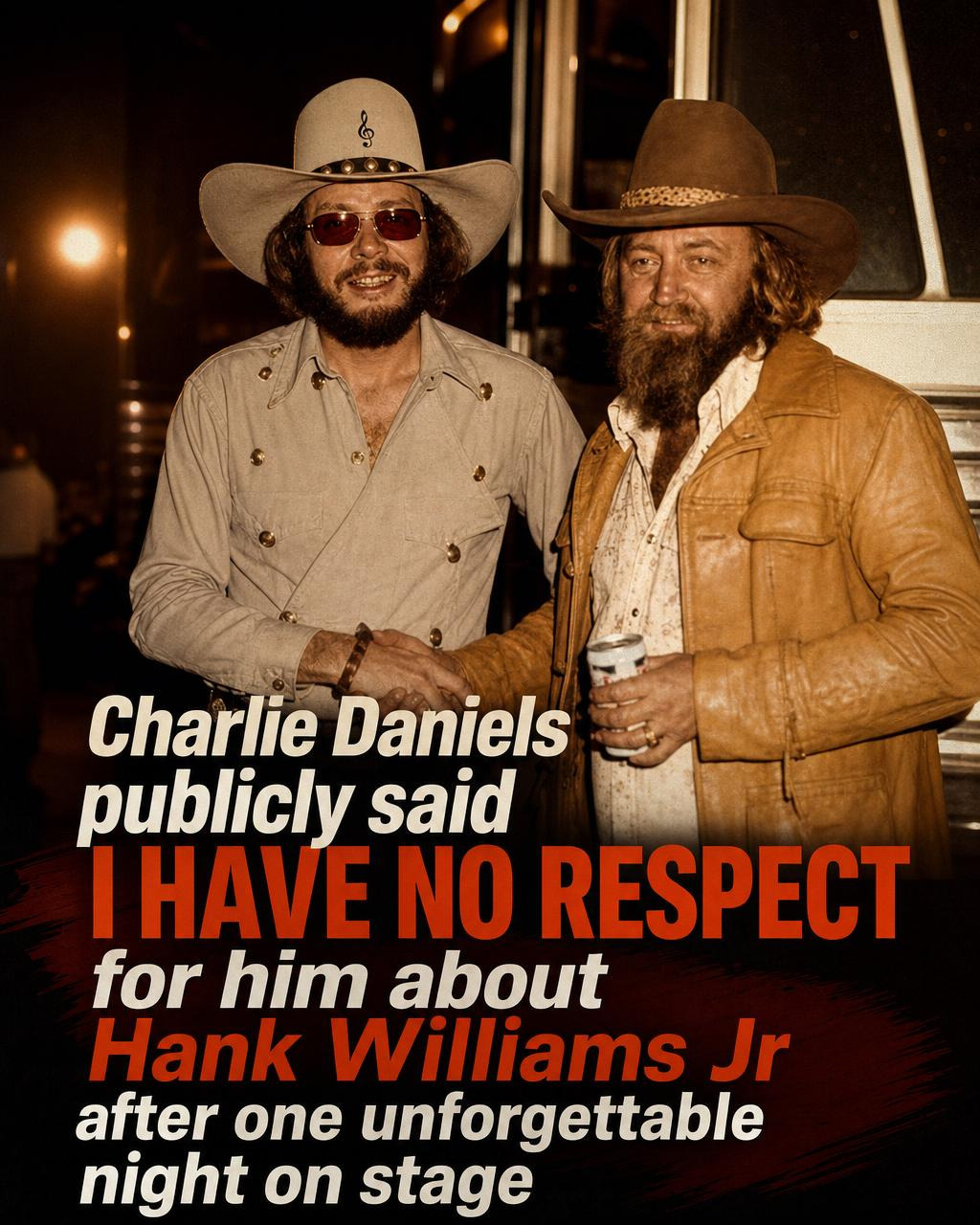
I Have No Respect for Him: The Hank Williams Jr. and Charlie Daniels Clash That Shocked Tennessee
On September 22, 1984, the Hooper Eblen Center at Tennessee Tech was supposed to host a straightforward country concert. Hank Williams Jr. and Charlie Daniels were co-headlining, and the order was simple: Hank Williams Jr. would go first, then Charlie Daniels would take the stage.
That kind of arrangement is built on trust. Each artist gets a turn. Each artist respects the clock. The crowd gets two full performances, and everyone walks away feeling like the night belonged to music instead of chaos.
But that is not what happened.
The Set That Would Not End
Hank Williams Jr. began his set, and the audience responded the way audiences do when a big star is in control of the room. The energy was strong. The songs kept coming. And then the minutes kept slipping away.
People behind the scenes tried to let him know his time was up. Hank Williams Jr. kept playing. The venue made a harder choice and cut the lights. When that did not stop him, they cut the sound entirely.
Even then, Hank Williams Jr. did not simply walk off.
He picked up an acoustic guitar and kept performing, carrying on through Charlie Daniels’ scheduled time. What should have been a smooth handoff turned into a public embarrassment, with the audience caught between confusion and disbelief.
Charlie Daniels Draws a Hard Line
Charlie Daniels did not soften his response. He described the moment as unprofessional and amateurish, and he made his feelings plain: “I have no respect for him.”
It was a sharp remark, but it came from a place many performers understand. A concert is more than a spotlight and a microphone. It is a schedule, a crew, a contract, and a promise to the next person waiting in the wings.
Respect onstage is not just about manners. It is about honoring the people who make the show possible.
Hank Williams Jr. Saw It Differently
Hank Williams Jr. did not frame the night as a failure of discipline. When speaking to David Allan Coe, Hank Williams Jr. said he had spent years performing alongside Waylon Jennings without problems and suggested he was simply being himself.
That response revealed the core of the conflict. Hank Williams Jr. was known for a rebellious streak and a larger-than-life style. Charlie Daniels came from a different mindset, one that placed a premium on professionalism and mutual respect. Neither man was unknown, and neither was short on pride.
In that sense, the clash was bigger than one night in Tennessee. It was about two kinds of stage presence: one built on instinct and defiance, the other on discipline and order.
What Happened After the Blowup
Despite the ugly moment, the story did not end there. Over time, the two men were able to patch things up enough to share stages again. That does not erase what happened at the Hooper Eblen Center, but it does show that even public grudges can cool with age.
Country music has always had room for strong personalities. Some of those personalities clash. Some make peace later. And sometimes, both things are true at once.
A Lesson That Still Holds Up
The 1984 incident remains memorable because it was not just about ego. It was about timing, fairness, and the basic respect every opening act and headliner owes each other. Talent matters. Presence matters. But so does knowing when the song is over.
Hank Williams Jr. kept the crowd engaged. Charlie Daniels kept the line firm. And the night became a reminder that a great performance still has to fit inside a shared stage.
At the end of the day, there is such a thing as an opening act. Respecting that is not weakness. It is part of the job.