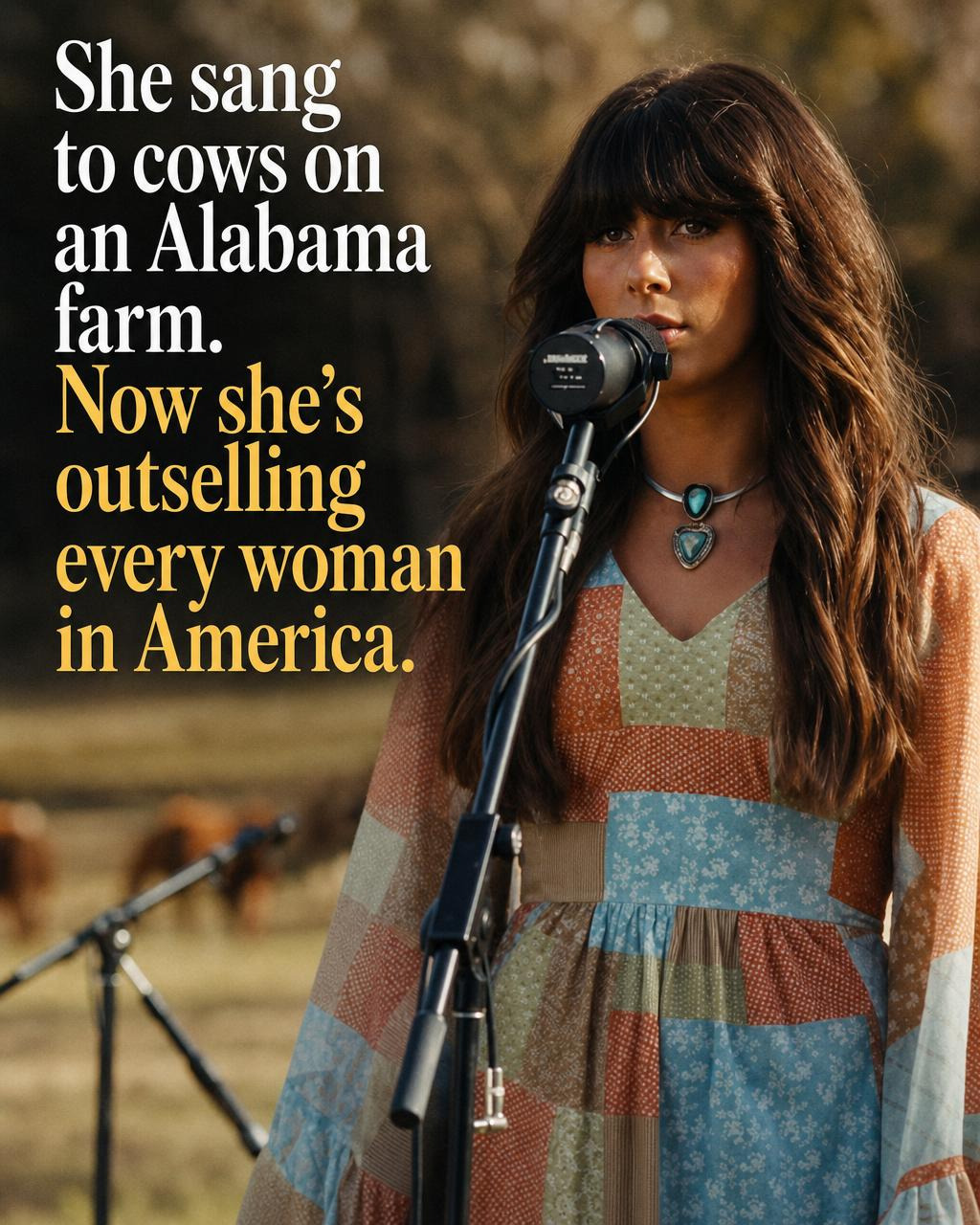
Ella Langley’s Rise From an Alabama Farm to the Top of the Charts
There is something deeply moving about a story that begins on a small family farm and ends at the top of the music industry. Ella Langley’s newest album, Dandelion, has become the best-selling album by a female artist in the United States so far in 2026. It is a country record, created far from the spotlight in Hope Hull, Alabama, a town of only about 2,000 people.
For many listeners, the numbers tell the story. Dandelion opened at No. 1 on the Billboard 200 with 169,000 units, then followed with another powerful week at 106,000. That made Ella Langley one of only three women with a country album to post back-to-back 100,000-plus weeks, joining the rare company of Beyoncé and Taylor Swift.
From Farm Life to a National Stage
Long before the charts and streaming records, Ella Langley was singing in a much quieter place. She grew up on a farm in Alabama, where music was part of daily life and singing to cattle was just one of the ways she found her voice. That image has stayed with fans because it feels so honest: no big industry machine, no polished shortcut, just a young artist learning how to be heard.
Her previous album had a very different outcome, debuting at No. 80. The jump from No. 80 to No. 1 is not just a career boost; it is a sign that something fundamental changed. Listeners connected to the music, the writing, and the sense that Ella Langley was making country music on her own terms.
The Miranda Lambert Connection
One of the biggest reasons Dandelion feels so grounded is the creative partnership behind it. Miranda Lambert co-produced the entire record, and that collaboration helped shape the album’s sound in a way that feels both classic and fresh.
“The album feels lived-in, confident, and emotionally direct,” is how many fans have described it, and that quality seems tied to the way Ella Langley and Miranda Lambert worked together.
Rather than pushing Ella Langley toward a pop crossover, the record leans into country storytelling, strong hooks, and a voice that sounds at home in its own skin. That decision mattered. In an era where many artists are told to broaden their sound to chase a wider audience, Ella Langley proved that a clear identity can still win on a massive scale.
A Song That Changed Everything
Much of the album’s momentum has been fueled by “Choosin’ Texas”, which has crossed 525 million global streams and spent 10 weeks atop the Hot 100. Those are enormous numbers for any artist, and even more striking for a country song that did not rely on a pop makeover to get there.
The success of Choosin’ Texas gave the album a larger cultural reach, but it also reinforced something fans already believed: Ella Langley does not need to sound like anyone else to matter. Her strength is in the directness of her voice and the emotional clarity of her songs.
Why This Moment Feels Bigger Than One Album
Ella Langley’s success is personal, but it also feels symbolic. It shows that an artist can come from a small town, stay rooted in country music, and still dominate a national conversation. It also shows that audiences are willing to reward authenticity when the songs are strong enough to carry it.
From singing to cattle on a farm in Alabama to outselling every woman in America, Ella Langley’s journey is the kind of music story people remember. It is not just about numbers, and it is not just about fame. It is about a voice, a place, and a record that connected at exactly the right moment.
And for Ella Langley, this may only be the beginning.