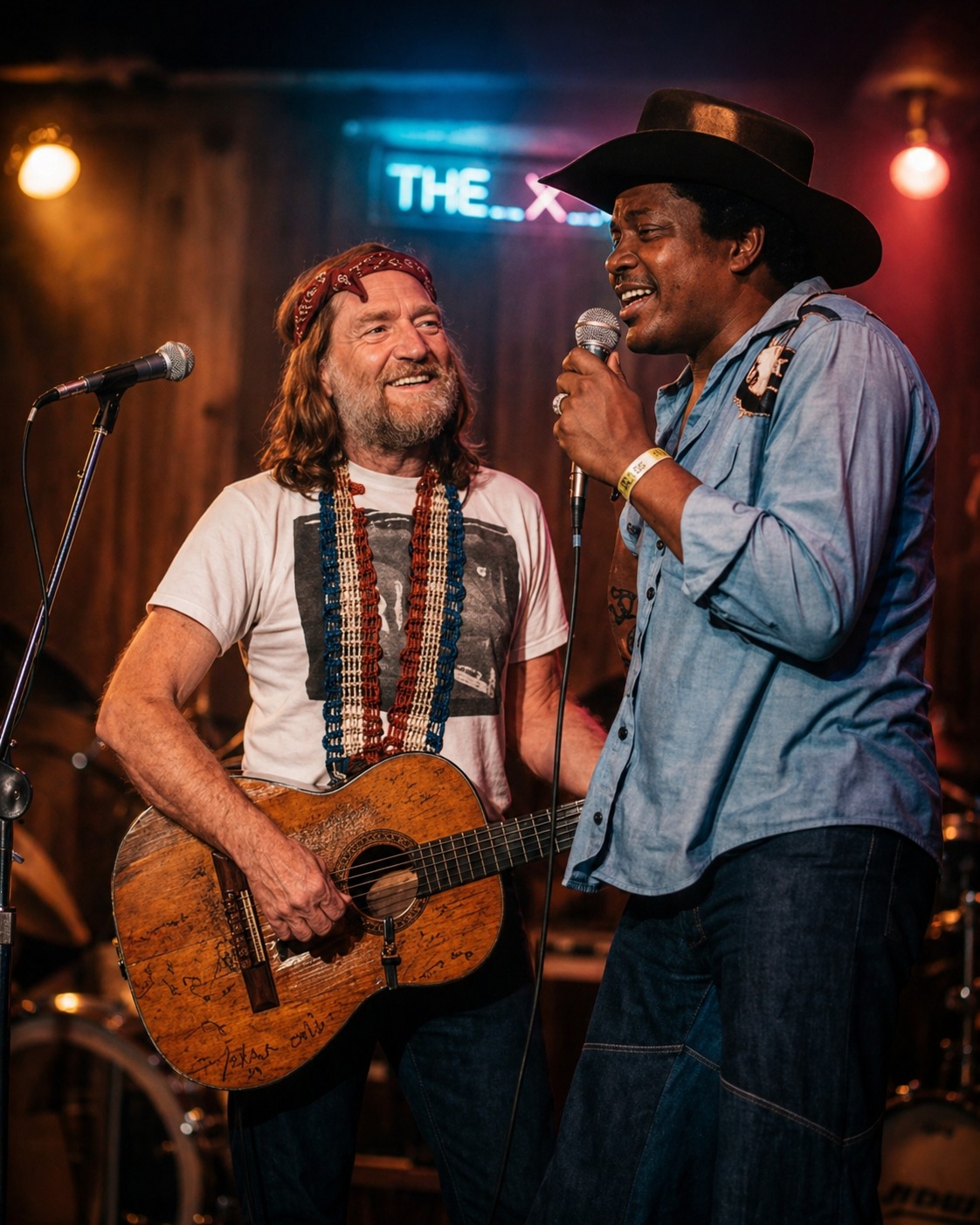
In 1967, Willie Nelson Didn’t Give a Speech for Charley Pride. He Did Something Louder.
Sometimes history does not announce itself with a speech. Sometimes it arrives in one bold, unforgettable gesture.
In the early years of Charley Pride’s rise, country music was not ready to be honest about what it was hearing. RCA Records understood that Charley Pride had a voice people could not ignore, but they also understood the prejudice of the era. So when those early records were released, Charley Pride’s face was not on the cover. The label wanted country radio to hear the singing first and confront the man later.
That strategy says everything about the world Charley Pride entered. The music could be welcomed before the artist was. The voice could be praised while the person behind it was left to wait outside the door.
When Charley Pride stepped onto stages in front of white country audiences, he often walked into silence that felt heavier than any spotlight. Some crowds did not know what to expect, and some already thought they knew too much. Charley Pride learned to answer that tension with grace and a little humor.
“Ladies and gentlemen, I realize it’s a little unique… me coming out here wearing this permanent tan.”
That line was more than a joke. It was Charley Pride taking control of the room before the room could control him. It was dignity, delivered with a smile. It was a way of saying, I know what you see, and I know what you think, but listen anyway.
Then came one of those moments that fans remember not because it was polished, but because it was real.
At the Big D Jamboree in Dallas in 1967, Willie Nelson did not stand up and deliver a carefully written speech about fairness or inclusion. He did not pause to explain what the moment meant. He did something faster, riskier, and far more visible. Willie Nelson kissed Charley Pride onstage.
It was not presented as a joke. It was not hidden behind irony. It was a public sign of respect, a fearless gesture that told the crowd exactly what Willie Nelson believed: Charley Pride belonged there.
That kind of support matters, especially in a world where silence can be used as a weapon. Willie Nelson did not wait for the room to become comfortable. Willie Nelson made the room confront its own discomfort. And then Charley Pride did what he always did best: he sang.
That is the part that made the gesture even stronger. Charley Pride did not need rescuing. Charley Pride needed room to be heard. Once the music started, the voice did the rest. It carried. It won people over. It changed minds one listener at a time.
The career that followed was extraordinary. Charley Pride went on to score twenty-nine No. 1 hits and fifty-two Top 10 singles. He became one of country music’s biggest stars, not as a symbol alone, but as a serious artist with a powerful catalog and a sound that connected across generations. Later, Charley Pride earned a place in the Country Music Hall of Fame, where his legacy became impossible to separate from the story of country music itself.
But the most moving part of this story may be the ending, because it closed a circle that few people could have imagined back in 1967.
In 2020, Charley Pride received his final public honor: the Willie Nelson Lifetime Achievement Award.
Fifty-three years after Willie Nelson stood beside him in Dallas, Charley Pride held an award carrying Willie Nelson’s name. That detail feels almost too perfect, almost too quiet to be real. Yet it is real, and that is why it stays with people.
It reminds us that the history of music is not only made of hit records and trophy counts. It is also built from moments of courage, moments of solidarity, and moments when one artist chooses to make space for another in full view of the world.
Willie Nelson did not give a speech for Charley Pride in 1967. Willie Nelson gave him something louder: public respect, without hesitation.
And Charley Pride answered with the only response that could outlast prejudice, suspicion, and silence. Charley Pride sang. Then Charley Pride became unforgettable.