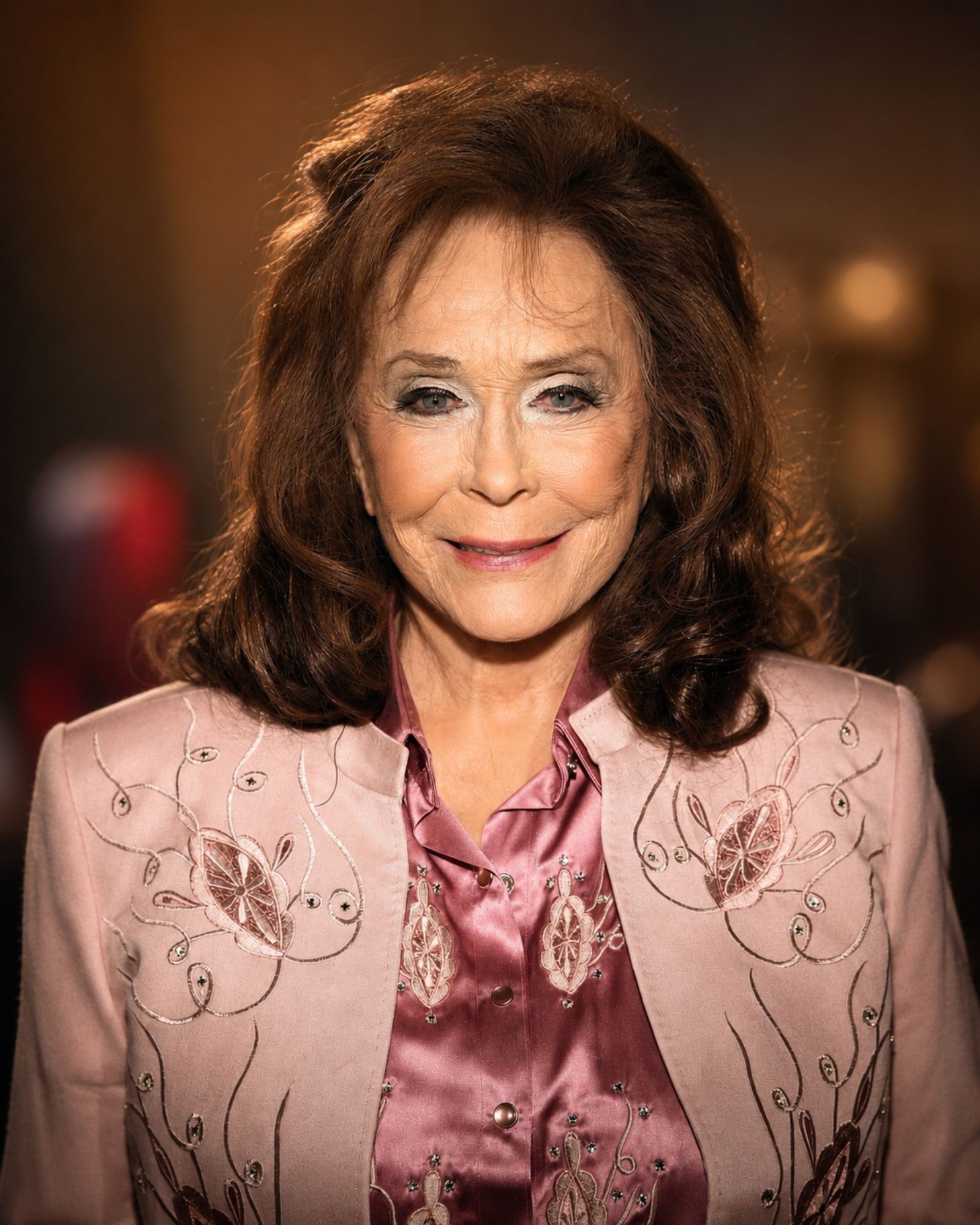
She Died on a Tuesday. By the End of the Week, Her Streams Jumped 1,841% in a Single Day — and Nashville Still Wasn’t Done Saying Goodbye
Loretta Lynn did not come from comfort. She grew up barefoot in a coal mining cabin in Butcher Hollow, Kentucky, and learned early that life could be hard, unfair, and loud all at once. Married at 15. A mother at 16. A grandmother before she turned 30. Those facts alone could have become the whole story, but Loretta Lynn turned them into something bigger: songs that told the truth.
For decades, Loretta Lynn sang about the lives many people were living but not saying out loud. She wrote about cheating husbands, family struggles, birth control, and women who were tired of being told to stay quiet. Some radio stations banned her songs because they were too honest. That never seemed to bother Loretta Lynn much. If anything, it made the point stronger.
The Voice That Would Not Back Down
Loretta Lynn had a way of sounding like someone speaking directly to you from the kitchen table. Her music felt personal because it was personal. She did not sing from a distance. She sang from lived experience, with all the grit and heart that came with it. That is part of why fans connected with Loretta Lynn for so long. She made people feel seen.
By the time she died in her sleep on October 4, 2022, at her ranch in Hurricane Mills, Tennessee, Loretta Lynn was 90 years old and already a legend in every sense of the word. But even then, the response to her passing showed just how deep her influence ran. Within hours, listeners turned to her songs again. Streaming numbers climbed fast. Downloads surged. One of the biggest signs of that renewed attention was the way her catalog exploded across platforms, with listeners old and new pressing play as if they needed to hear her voice one more time.
Nashville Felt the Loss Immediately
In Nashville, the grief was not quiet. It was visible, public, and deeply personal. Fans shared memories. Artists spoke about her impact. Younger performers remembered the path Loretta Lynn had carved long before they ever stepped on a stage. Her music had helped make room for women to tell their own stories in country music without asking permission.
The numbers told part of the story. The emotion told the rest. One of the most beloved songs in her catalog, Coal Miner’s Daughter, surged back into heavy rotation. People were not only mourning Loretta Lynn. They were revisiting the life she had turned into art, and hearing it with fresh ears.
The Goodbye at the Grand Ole Opry
Then came the moment that made Nashville stop and gather itself around Loretta Lynn one more time.
Twenty-six days after her death, the Grand Ole Opry became the center of a farewell that felt as much like a celebration as a memorial. Thousands lined up outside with no guarantee of a seat, only the hope of being part of the room. Inside, 38 artists took the stage to honor a woman who had become one of country music’s most important voices.
The details mattered. Loretta Lynn’s gowns were displayed by the door. Her granddaughter walked through the room hugging strangers. The program included handwritten lyrics on the back, a small but powerful reminder that Loretta Lynn had always been both larger than life and deeply human.
“Loretta Lynn was not just a performer. Loretta Lynn was a witness to American life, and she made that life sing.”
Alan Jackson sat on a stool in the Opry’s legendary circle and sang a song he wrote for his own mother, and the room cracked open with emotion. George Strait was there. Dolly Parton was there. Jack White was there. Taylor Swift was there. Different generations, different sounds, one shared understanding: Loretta Lynn had changed the shape of country music forever.
Why Her Music Still Matters
Loretta Lynn’s legacy is not only about awards, sales, or streaming spikes, though those numbers were striking. It is about honesty. It is about a woman who took a life many would have overlooked and turned it into an American story that still resonates. She sang for people who felt ignored, judged, or underestimated. She sang for women who wanted more. She sang for families who knew what it meant to work hard and keep going.
That is why her death did not feel like an ending. It felt like a reminder. The songs remained. The stories remained. The voice remained.
Nashville did not just mourn Loretta Lynn. Nashville dressed up, showed up, and sang her home.
What Loretta Lynn song means the most to you?