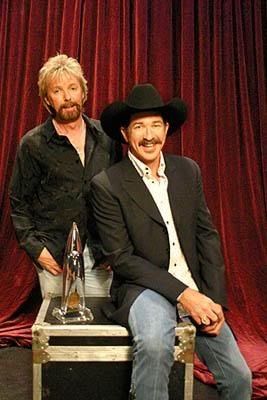
Ronnie Dunn and the Dream He Had to Leave Behind
The world saw Ronnie Dunn as one half of the most successful duo in country music history. The world heard the soaring voice behind “Boot Scootin’ Boogie,” “Neon Moon,” and “My Maria.” The world counted the awards, the sold-out arenas, the radio records, and the songs that became part of American country music memory.
But behind the bright lights of Brooks & Dunn was a quieter, more complicated story. Ronnie Dunn was not simply a man who found fame beside Kix Brooks. Ronnie Dunn was a man who spent many years trying to understand whether the dream he was living had ever truly been his own.
Before the awards, before the tours, before the Country Music Hall of Fame, Ronnie Dunn grew up in motion. Ronnie Dunn moved often as a boy, attending school after school, rarely staying long enough to feel fully rooted. His childhood carried two very different influences. His mother’s world was shaped by faith, church, and discipline. His father’s world carried the rougher sound of honky-tonks, late nights, and restless energy.
For a time, Ronnie Dunn tried to follow the steadier path. Ronnie Dunn enrolled at Hardin-Simmons University with the intention of becoming a Baptist preacher. It seemed like a life that might offer purpose, direction, and peace. But music kept pulling at Ronnie Dunn in a different direction. When Ronnie Dunn began singing in bars, that path toward the pulpit began to close.
So Ronnie Dunn chased music. But success did not come quickly. Ronnie Dunn released singles in the 1980s, but the country music world did not suddenly open its doors. The voice was there. The talent was there. Still, nothing seemed to catch fire. By 1990, Ronnie Dunn was in his mid-thirties, still performing in clubs, still waiting for a break that might never come.
Then came the meeting that changed everything.
Record executive Tim DuBois introduced Ronnie Dunn to Kix Brooks. The meeting was not the kind of instant brotherhood fans might imagine. Ronnie Dunn and Kix Brooks had both been chasing solo careers. Both had known frustration. Both had their own ideas, their own instincts, and their own pride. Joining forces did not feel natural at first. In fact, the idea seemed almost strange.
Two men who had each wanted a solo career were suddenly asked to become a duo.
But Ronnie Dunn and Kix Brooks signed on. And almost overnight, everything changed.
Brooks & Dunn became a country music force. The songs were huge. The concerts were electric. The image was powerful: Kix Brooks with the energy and showmanship, Ronnie Dunn with that unmistakable voice cutting straight through the room. Together, Brooks & Dunn became bigger than either man had been alone.
To fans, it looked like destiny. To Ronnie Dunn, it was more complicated.
Success can be a beautiful thing. Success can also become a cage when it grows larger than the person inside it. For Ronnie Dunn, the duo brought everything an artist is supposed to want: number-one hits, awards, money, recognition, and a permanent place in country music history. But it also required compromise, constant public energy, and the discipline of sharing every major decision with another strong personality.
Ronnie Dunn later described the ride with the kind of honesty that makes success sound less glamorous and more human. It was fast, loud, thrilling, and difficult to stop. The machine kept moving. The fans kept cheering. The songs kept coming. And somewhere inside it all, Ronnie Dunn had to keep asking a private question: Where do I end, and where does Brooks & Dunn begin?
That is the part fame rarely allows. When the public loves an image, the person inside that image can feel guilty for wanting something else. Ronnie Dunn was part of a legendary duo, but Ronnie Dunn had once imagined himself standing alone. Not out of ego. Not out of bitterness. Simply because every artist wants to know the shape of his own voice without someone else’s name beside it.
In 2009, after nearly two decades of hits and history, Brooks & Dunn announced that they would step away from recording and touring as a duo. To the public, it was presented as a graceful ending, a mutual decision after an extraordinary run. But emotionally, the moment carried a deeper truth. Ronnie Dunn was not walking away from failure. Ronnie Dunn was walking away from a success so large that it had begun to blur his own identity.
That choice takes courage. It is one thing to leave when the dream has collapsed. It is another thing to leave when the dream is still working, when the crowds are still there, when the applause is still loud, and when the world believes you should simply be grateful.
Ronnie Dunn’s legacy will always include Brooks & Dunn. It has to. Those songs are permanent. Those performances mattered. That partnership changed country music.
But Ronnie Dunn’s story is not only about awards or record sales. Ronnie Dunn’s story is also about the quiet bravery of admitting that even a successful life can feel unfinished if it is not fully your own.
The world saw half of country music’s most awarded duo. Ronnie Dunn saw a man still searching for permission to be himself. And in the end, the most powerful note Ronnie Dunn ever reached may not have been onstage at all. It may have been the moment Ronnie Dunn finally chose to listen to the voice inside him.