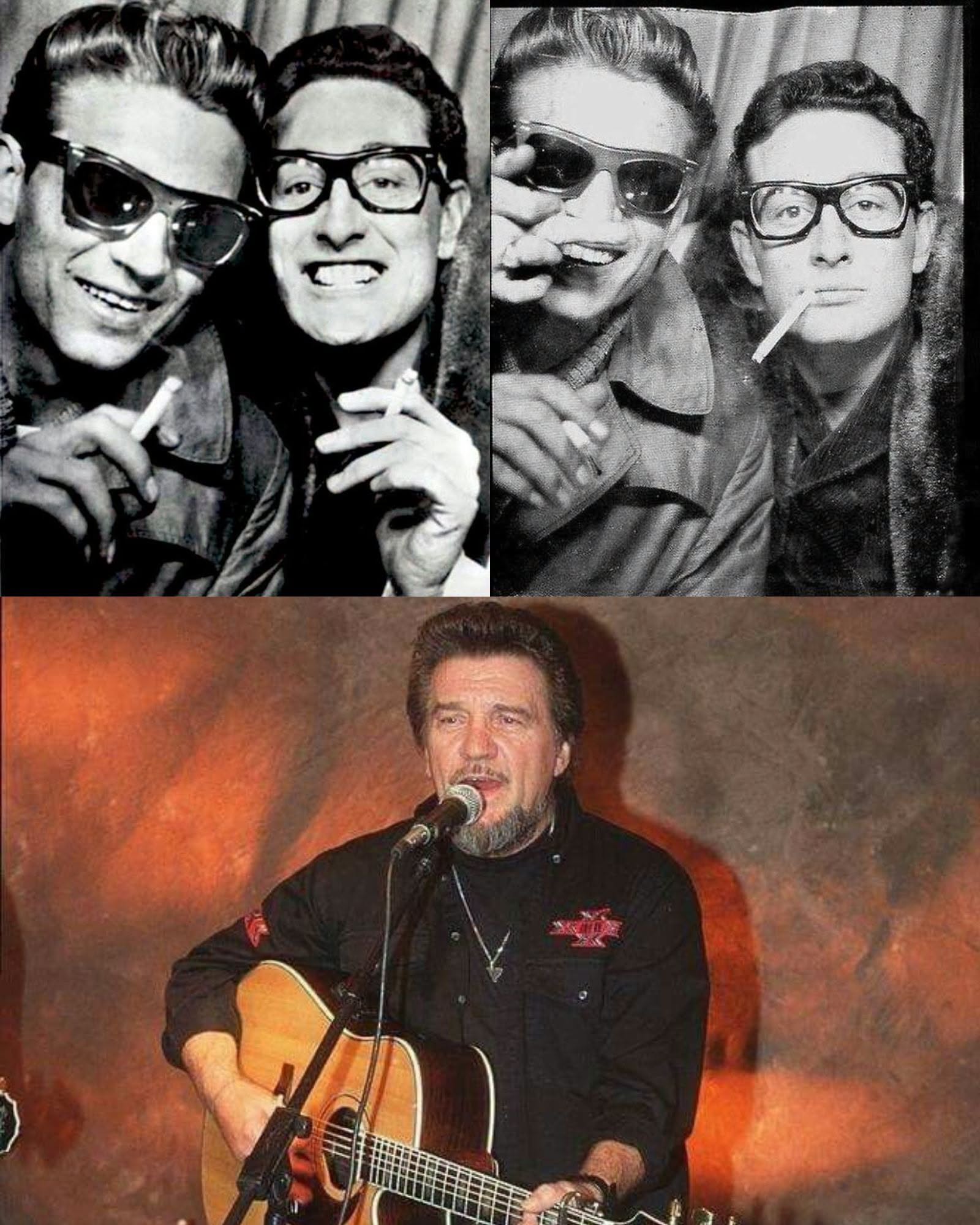
Don McLean turned February 3, 1959, into “the day the music died” in “American Pie.” For Waylon Jennings, that night was never a line in a song. He had given his own seat on the plane to someone else, and the last words he spoke to his best friend were a joke he would spend years trying to hide.
Here is how that night unfolded, as Waylon himself told it.
The friend who believed in him first
In 1958, Waylon Jennings was a young disc jockey at KLLL radio in Lubbock, Texas. Buddy Holly, already a star, took a liking to him. Buddy produced Waylon’s very first record, a version of the Cajun standard “Jole Blon,” and played guitar on the session, with King Curtis on saxophone.
When Buddy needed a bass player for a winter tour, he walked into the station, handed Waylon an electric bass and told him he had two weeks to learn it. Waylon was a guitarist. He learned anyway.
Decades later, Waylon put it plainly:
“Buddy was the first guy who had confidence in me.”
A seat on a small plane in Clear Lake
The Winter Dance Party tour of early 1959 was brutal. The band rode an old bus through the upper Midwest in subzero cold, and the heater kept failing. By the time they played the Surf Ballroom in Clear Lake, Iowa, on February 2, Buddy Holly had had enough. He chartered a four-seat Beechcraft Bonanza to fly ahead toward Fargo, North Dakota, for the next show in Moorhead, Minnesota, so he could rest and get laundry done.
The seats were meant for Buddy, Waylon Jennings and guitarist Tommy Allsup. Ritchie Valens won Allsup’s seat on a coin toss.
Then J.P. “The Big Bopper” Richardson came to Waylon. He was sick with the flu, and as a big man he could not get comfortable on the cramped bus seats. Waylon later recalled that Richardson told him he hadn’t been able to sleep and asked if he could take his place. Waylon said yes.
The hot dogs and the cane-bottom chair
The last time Waylon saw Buddy, Buddy had sent him out for hot dogs. When Waylon came back, Buddy was tipped back against the wall in a cane-bottom chair, laughing at him.
Buddy teased him for not flying. It was bitterly cold outside, and Buddy said he hoped Waylon’s bus froze up. Waylon gave it right back:
“Well, I hope your ol’ plane crashes.”
It was the kind of ribbing the two of them traded all the time. The wording of Buddy’s line varies a little from one telling to the next, but Waylon’s reply is the same in every version he gave.
“The guys didn’t make it”
The plane took off from the Mason City airport around 1 a.m. on February 3, 1959, into snow and poor visibility. Within minutes it went down in a field a few miles away. Buddy Holly, Ritchie Valens, J.P. Richardson and the young pilot, Roger Peterson, were all killed.
Waylon and the rest of the band went on by bus. Waylon later remembered the tour manager asking to speak with them outside. Waylon turned to Tommy Allsup and told him to go. Allsup stepped out and came back a moment later with the news that the plane had crashed and none of them had made it.
“I was just numb,” Waylon said.
The words he kept to himself
What stayed with Waylon was not only the loss. It was what he had said. In his 1996 autobiography, he admitted for the first time how heavy that joke had been. He wrote that he had been afraid for many years that somebody was going to find out he said it, and that somehow he blamed himself.
There was a second weight, too. Waylon was alive, sitting in a seat on a bus, while the man in his plane seat was gone. He wrote that he felt guilty for still being here when, at that point, he hadn’t contributed anything compared to Buddy.
He went back to Texas with little desire to play, turned down a chance to join a re-formed Crickets, and returned to radio work in Lubbock. When his son was born the following year, Waylon named him Buddy.
“Old Friend,” seventeen years later
By 1976, Waylon Jennings was one of the biggest names in country music, leading the outlaw movement. That June he released Are You Ready for the Country, which went on to spend 10 weeks at No. 1 on the country albums chart and was certified gold.
Tucked onto the album was “Old Friend,” a song Waylon wrote by himself for Buddy Holly. It does not retell the crash. Instead, it opens on the moment Waylon carried with him: the last time he saw Buddy laughing at him before he flew away. The chorus tells Buddy he has been missed, while teasing that he hasn’t missed much. One verse jokes that the stories people tell make Buddy sound like an angel, though the two of them knew better. It closes by saying Buddy was many things to many people, but to Waylon he was a friend.
Waylon never stopped crediting him. In a 1999 interview with CMT, he said that if anything he had done was remembered, part of it was because of Buddy Holly.
Waylon Jennings died in 2002. The song is still there, holding onto a young man laughing in a cane-bottom chair on a cold night in Iowa.