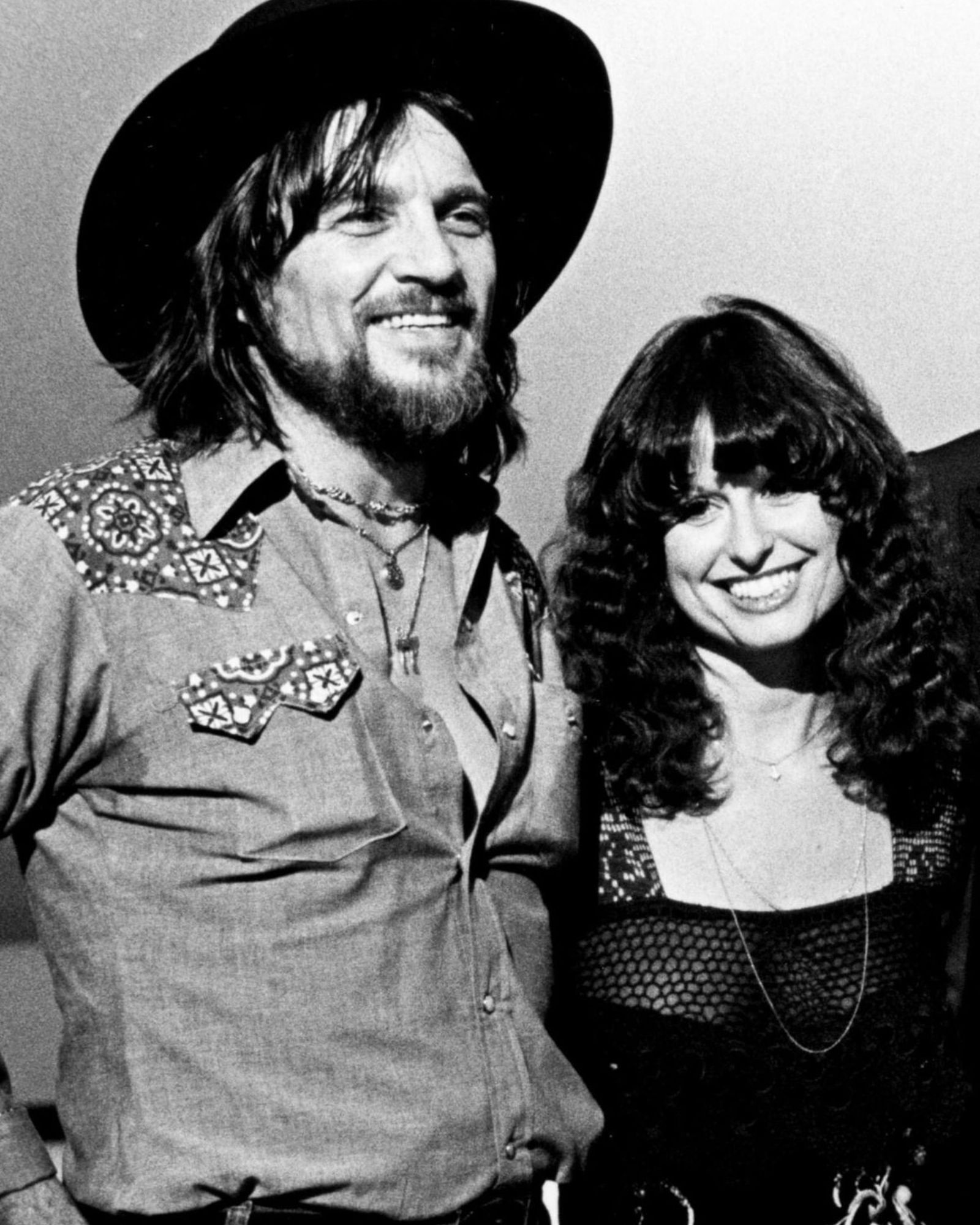
Waylon Jennings recorded one of the most memorable love songs in country music, but the woman behind its deepest meaning wasn’t named Amanda. It was Jessi Colter, the wife who had stood beside Waylon Jennings through some of the hardest years of their marriage.
In 1990, during a conversation with Los Angeles Times journalist Robert Hilburn, Waylon Jennings revealed something that gave the familiar song an entirely different meaning. One particular line always reminded Waylon Jennings of Jessi Colter, and the reason had little to do with the kind of romance usually celebrated in country music.
A Conversation on the Tour Bus in 1990
Waylon Jennings was touring with Johnny Cash, Willie Nelson, and Kris Kristofferson as part of the Highwaymen when Robert Hilburn joined the musicians on the road.
During a late-night bus ride, Jessi Colter sat beside Waylon Jennings near the front of the vehicle. The conversation turned to music, memories, and the experiences that had shaped Waylon Jennings’ career.
Earlier, Waylon Jennings had discussed the part of “Amanda” describing the pleasures of playing in a country band. Nearly an hour later, Waylon Jennings returned to the song, this time focusing on something much more personal.
Waylon Jennings explained that the line suggesting Amanda deserved a gentleman for a husband always affected him deeply.
“That line hits hard every time I sing it. I think of Jessi.”
It was an extraordinary admission from a performer whose public image had been built around independence, rebellion, and the outlaw country movement.
For Waylon Jennings, that line wasn’t simply about a fictional woman. It reminded Waylon Jennings of what Jessi Colter had endured during their marriage.
What Jessi Colter Had Lived Through
Waylon Jennings and Jessi Colter married in 1969. Both were talented musicians, but their years together were not always easy.
As Waylon Jennings became one of country music’s biggest stars, Jessi Colter witnessed the difficult side of that success. Long tours, professional pressures, and Waylon Jennings’ struggles with drug addiction placed enormous strain on their relationship.
In the same 1990 interview, Waylon Jennings acknowledged that seeing the pain caused to Jessi Colter had been the turning point that motivated him to stop using drugs.
Waylon Jennings described recognizing the damage his behavior had caused. Neither career troubles nor the effects on his own performances had been enough to produce the same realization.
That history explains why “Amanda” became so personal. Its narrator recognizes that the woman sharing his life deserved better than the circumstances he had given her. Waylon Jennings heard something of his own marriage in that confession.
The Surprising History of “Amanda”
Yet there is another fascinating part of the story: Waylon Jennings didn’t write “Amanda.”
The songwriter was Bob McDill, who created the composition in approximately thirty minutes. According to the Country Music Hall of Fame, Bob McDill originally tried to get the song to Waylon Jennings, but that attempt was unsuccessful.
Don Williams recorded “Amanda” in 1973, introducing the song to country audiences. Waylon Jennings loved the Don Williams recording and eventually recorded his own version for the 1974 album The Ramblin’ Man.
But the song wasn’t released as a Waylon Jennings single at the time.
More than four years later, the recording received additional production work and appeared on the 1979 Greatest Hits album. Released as a single that year, “Amanda” reached No. 1 on Billboard’s country chart and remained there for three weeks.
Bob McDill had written the song. Don Williams had recorded it first. But Waylon Jennings gave it a personal connection that listeners could hear without necessarily knowing the story.
The Meaning That Stayed With Waylon Jennings
When Robert Hilburn revisited the conversation in a February 2002 tribute following Waylon Jennings’ death, the journalist remembered the tenderness beneath the famous outlaw image.
That is what makes the story of “Amanda” so remarkable. The song was never originally written as a tribute to Jessi Colter, and Waylon Jennings never claimed otherwise.
Instead, Waylon Jennings found his own truth in another songwriter’s words.
Millions of listeners heard a country singer addressing a woman named Amanda. But for Waylon Jennings, one line carried the memory of Jessi Colter, the woman who had shared his successes, witnessed his struggles, and remained an important part of his life.
Sometimes the deepest meaning of a country song isn’t found in the story of how it was written. It comes from the life of the person singing it.
And for Waylon Jennings, “Amanda” would always carry a little of Jessi Colter’s story, too.