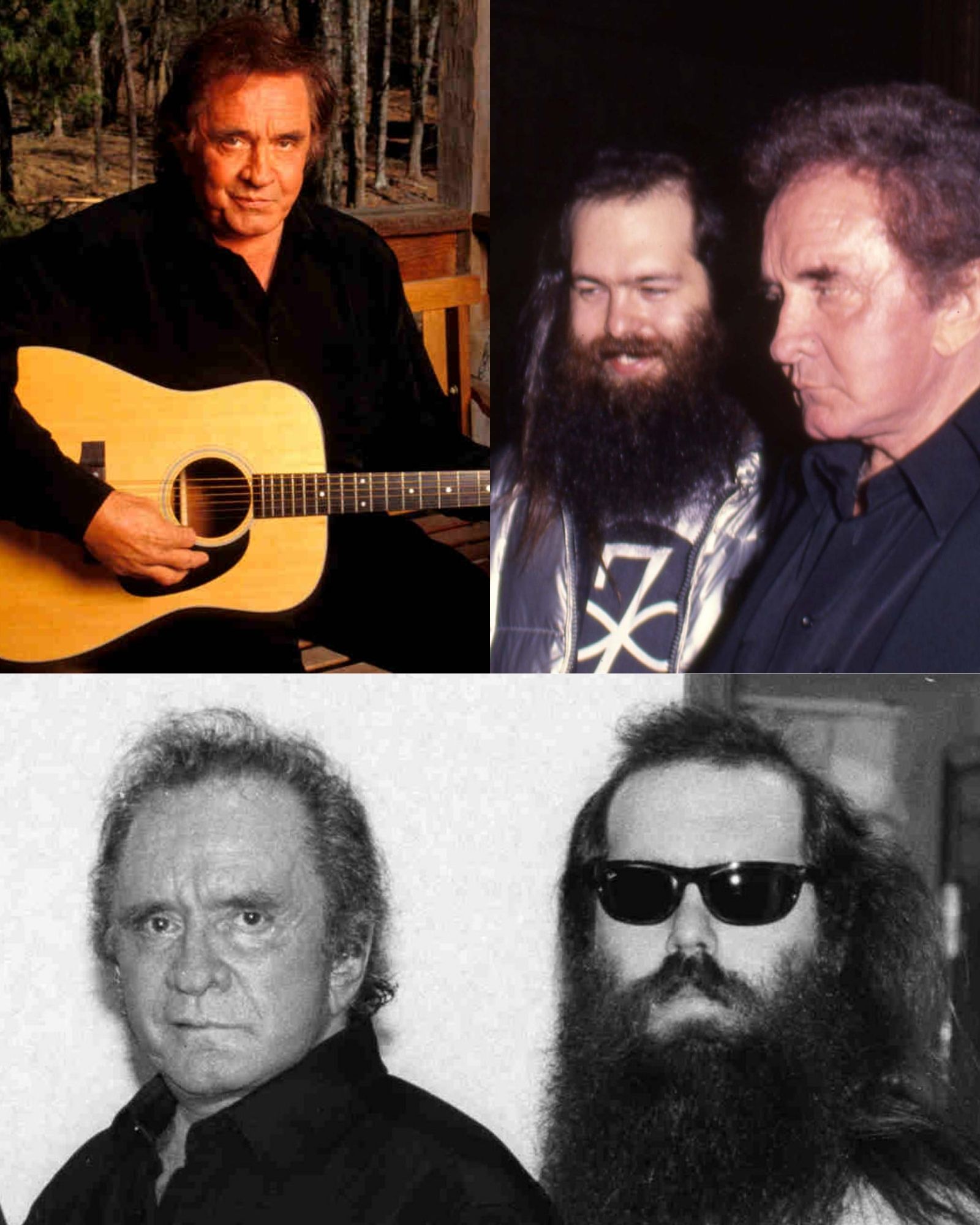
On February 27, 1993, one day after his 61st birthday, Johnny Cash finished a show at the Rhythm Cafe in Santa Ana, California, and sat down at a table backstage with a bearded 29-year-old named Rick Rubin. Rubin had produced the Beastie Boys, Run-DMC and Slayer. Cash had made Folsom Prison and San Quentin famous. For about two minutes, neither man said a word.
What came out of that table was not a hit single or a new band. It was a living room, a guitar and two microphones, and the last ten years of Johnny Cash’s working life.
A legend on the dinner-theater circuit
By the early 1990s, Cash’s place in the music business had shrunk to almost nothing. Columbia Records, his home since 1958, let him go in July 1986. The story long told in Nashville is that he learned about it from the newspaper. Mercury picked him up, but his records there sold poorly, and by 1991 that relationship was finished too. Country radio had moved on to younger men in bigger hats.
He spent much of 1992 working a residency in Branson, Missouri, the vacation town of theaters and buffets, where he had a theater bearing his name. His body was failing him as well. His son, John Carter Cash, later described a father recovering from a jaw broken during dental surgery, a knee operation, and chronic pain he could no longer treat with opiates.
The show in Santa Ana fit the pattern. Rubin later remembered it as a dinner theater in Orange County, with maybe 150 people eating at tables while Cash played. He compared it to the retirement circuit.
Two minutes of silence in Santa Ana
Rubin had asked for the meeting through Cash’s manager, Lou Robin, who had never heard of him. Cash assumed this was one more record executive with a plan to put him back on the charts. He had heard plenty of those. After the show, Robin brought Rubin backstage anyway.
Cash’s first impression of the producer was memorable. He later described Rubin as the ultimate hippie, bald on top with hair falling past his shoulders, a beard that looked like it had never seen scissors, and clothes a drifter might wear.
John Carter Cash was in the room. He later recalled that the two men said hello, then simply sat and looked at each other for about two minutes, as if each was measuring the other. Rubin’s own memory of it was gentler. He said they sat side by side for a long time without talking, and that something passed between them he could never quite explain.
One question, one honest answer
Cash finally broke the silence with the question he had been asking every label for years:
What’re you gonna do with me that nobody else has done to sell records for me?
Rubin did not promise him anything. He told Cash he wasn’t sure they would sell any records at all.
What he wanted instead was simple. Cash would come to his house, sit in the living room with a guitar and a pair of microphones, and sing every song he had ever wanted to record. No band, no Nashville arrangement, no producer telling him which of his old hits to cut again. Cash said that sounded good to him.
His daughter Rosanne later admitted she wondered whether Rubin meant to make some kind of joke out of her father.
The living room off Sunset Strip
Cash signed with Rubin’s American Recordings label in June 1993. Before they ever recorded, the two traded cassettes and CDs between Los Angeles and Nashville. Rubin would send discs with one song, or thirty, and Cash would call back with the ones he liked.
The sessions began in Rubin’s home above the Sunset Strip. Lou Robin remembered a small room with a couple of couches and easy chairs, recording gear along one wall and heavy drapes to deaden the sound. Cash would walk in, sit down and play. Over the summer of 1993 he cut more than 70 solo acoustic demos, many of them more than once.
Cash said the setup gave him a strong sense of déjà vu. It reminded him of 1955, standing in front of Sam Phillips’s microphone at Sun Records while Phillips asked him for one more song.
They did try full bands. In the end, Rubin said, they both preferred those first bare demos, and that became the album. The last sessions in late 1993 were split between Rubin’s living room and the Cash Cabin on Cash’s property in Hendersonville, Tennessee, a plain room with a small mixing board and two microphones.
The night at the Viper Room
Before the record came out, Rubin asked Cash to try the songs alone in front of a crowd. On December 3, 1993, about 150 people packed the Viper Room in West Hollywood. Cash had never relied on his own guitar to carry a show, and he was nervous. After the first song, Robin said, the nerves left him. Two songs recorded that night made the album.
Ten more years
American Recordings was released on April 26, 1994, when Cash was 62. In March 1995 it won the Grammy for Best Contemporary Folk Album. He and Rubin kept going, through Unchained, Solitary Man and The Man Comes Around, the album with his version of Hurt. They were still recording when Cash died on September 12, 2003, a little more than ten years after that table in Santa Ana. Two more volumes were released after his death.
Lou Robin, the manager who had never heard of Rick Rubin, later said he believed those albums probably added ten years to Johnny Cash’s life. Not just to his career, he said, but to the man himself, because he finally had something exciting to do again.