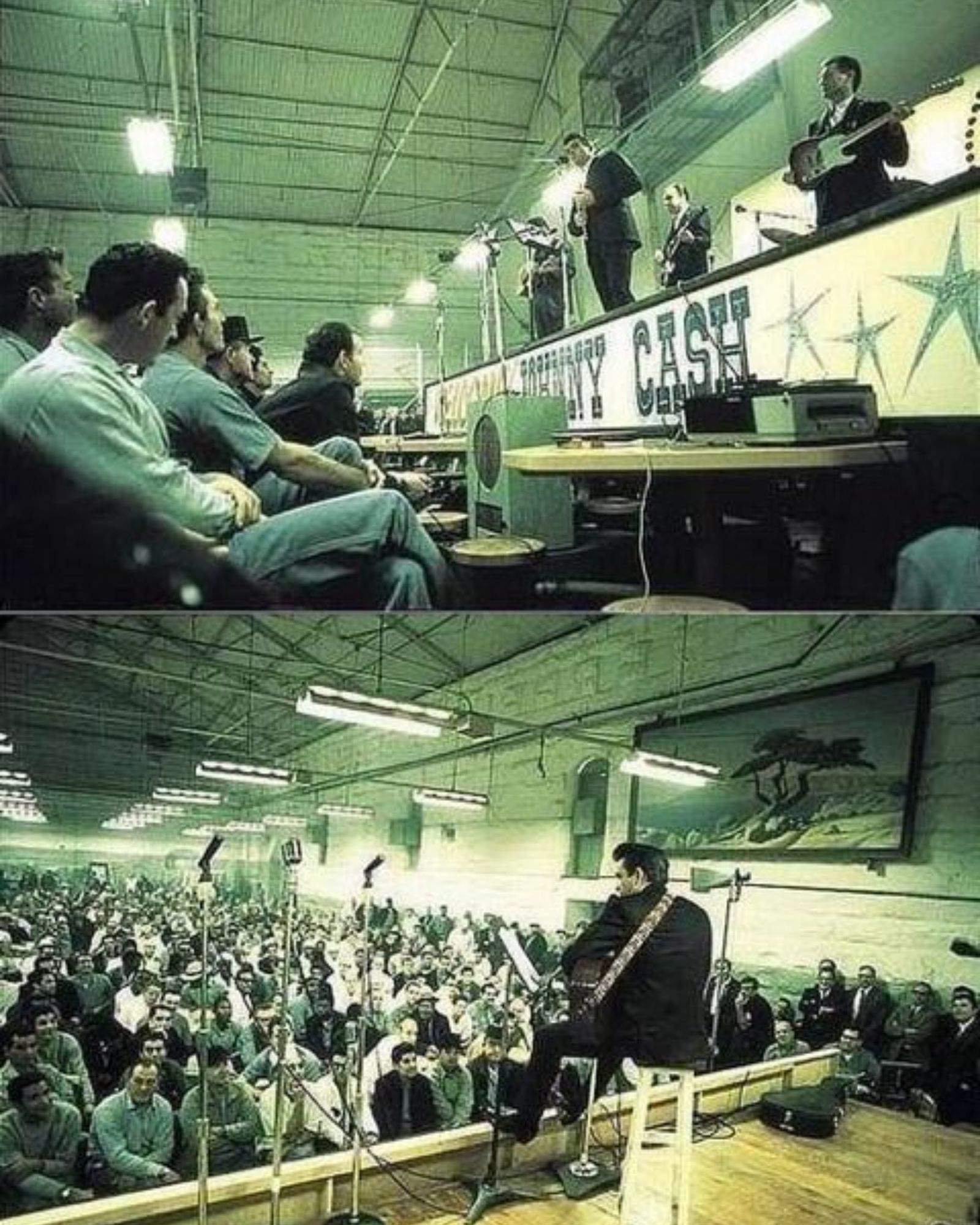
On February 24, 1969, Johnny Cash gave one of the most important performances of his career inside San Quentin State Prison in California. The concert would produce a number-one album, an unforgettable hit single, and another remarkable chapter in the history of country music.
But according to Johnny Cash’s own recollection, something happened after the performance that never became part of the famous live album.
As Johnny Cash was leaving the prison, men confined to Death Row began calling out from their cells. They wanted the country singer to perform one more song.
Johnny Cash stopped, took out a guitar, and sang for them.
A Country Legend Finds a New Beginning
By the late 1960s, Johnny Cash was already an established country star. Songs such as “I Walk the Line,” “Ring of Fire,” and “Folsom Prison Blues” had made Johnny Cash a familiar voice across America.
But Johnny Cash’s career had also experienced difficult years. Personal struggles, demanding touring schedules, and changes in the music business had taken a toll.
Then came January 13, 1968.
Johnny Cash recorded two concerts at Folsom Prison, performing before an audience of incarcerated men. The resulting album, At Folsom Prison, became a major commercial success and helped restore Johnny Cash’s standing as one of country music’s leading performers.
The connection with prison audiences was not new. Johnny Cash had been performing inside correctional facilities since the 1950s, including a 1958 appearance at San Quentin.
Those concerts meant something personal to Johnny Cash. Although Johnny Cash had never served a prison sentence, the singer understood that many people behind bars still wanted dignity, encouragement, and a chance to be heard.
February 24, 1969: The Concert at San Quentin
When Johnny Cash returned to San Quentin in February 1969, cameras from Britain’s Granada Television were present to document the performance.
Johnny Cash delivered a powerful set that included familiar hits, gospel music, and newly introduced material. One song, written specifically about San Quentin, drew such an intense response that Johnny Cash performed it twice.
Another highlight was “A Boy Named Sue,” written by Shel Silverstein. Johnny Cash was still learning the lyrics and used a sheet of paper during the performance.
That recording eventually reached number two on the Billboard Hot 100, becoming Johnny Cash’s biggest pop single.
Released on June 4, 1969, At San Quentin went even further than its celebrated predecessor. The album reached number one on the Billboard 200 on August 23, remaining there for four weeks. It became Johnny Cash’s only album to top that chart during the singer’s lifetime.
The album also won CMA Album of the Year, while Johnny Cash received the CMA Entertainer of the Year award in 1969.
Yet the remarkable moment after the concert had nothing to do with record sales or trophies.
The Men Who Asked for One More Song
Years later, Johnny Cash recalled walking past the prison’s Death Row area after leaving the stage.
Prisoners began shouting from their cells, asking Johnny Cash to sing.
Johnny Cash could have continued walking. The scheduled performance was finished, and the recording equipment had already captured the concert that would soon become famous.
Instead, Johnny Cash remembered taking out a guitar and performing “Folsom Prison Blues” on the pavement outside the prison.
The account survives through Johnny Cash’s own words, rather than a known film recording of that particular encounter. But it reveals something important about the relationship Johnny Cash had developed with incarcerated audiences.
Johnny Cash did not reserve that connection for the stage.
The Commitment Continued Beyond the Music
The concern Johnny Cash showed toward prisoners continued after the commercial success of the two live albums.
In 1972, Johnny Cash testified before a United States Senate judiciary subcommittee examining prison reform. Johnny Cash supported rehabilitation and argued for approaches that would give people a better opportunity to rebuild their lives.
For Johnny Cash, performing in prisons had become more than an unusual concert tradition. It was also a way to recognize people whose voices rarely reached the outside world.
Millions of listeners eventually heard the music recorded at San Quentin. The album became one of the defining achievements of Johnny Cash’s career.
But the men calling from their cells after the cameras stopped recording were not asking for a chart-topping album.
They simply wanted Johnny Cash to sing.
And according to the singer’s own account, Johnny Cash did.