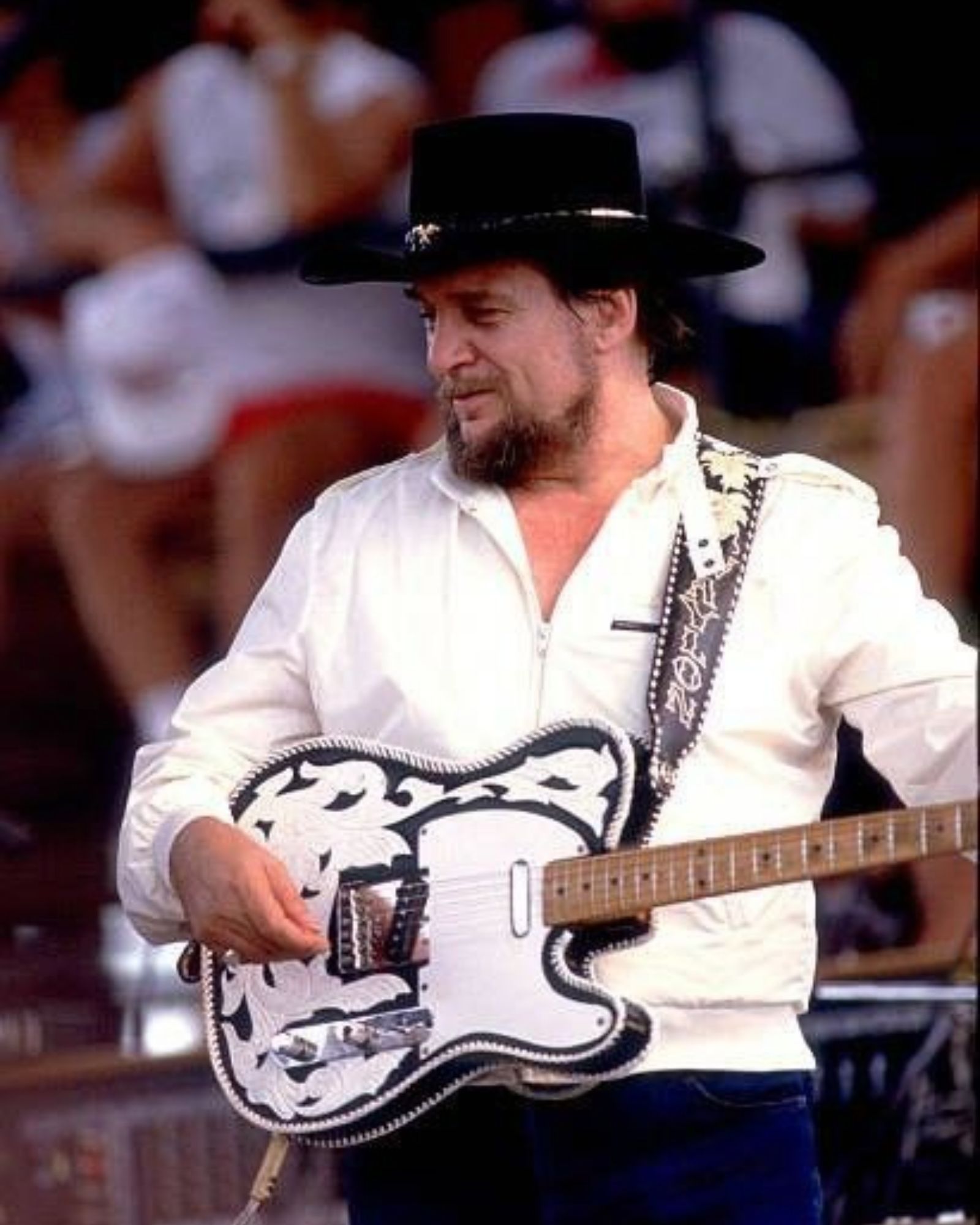
On March 23, 2002, the Ryman Auditorium in Nashville hosted a memorial service for one of country music’s most unforgettable voices. Waylon Jennings had died more than a month earlier, on February 13, at the age of 64. Friends, family members, fellow musicians, and longtime fans came together to remember the man who had helped change the direction of country music.
For nearly two hours, the gathering celebrated Waylon Jennings through stories, performances, and memories. But the most remarkable moment was saved for the very end.
When the final song began, the voice coming through the Ryman’s speakers belonged to Waylon Jennings.
A Cowboy Hat, a Guitar, and an Empty Stage
The stage carried familiar reminders of Waylon Jennings’ life on the road. A black backdrop displayed the large silver “W” from the touring show. Waylon Jennings’ black guitar stood beneath it, with a black cowboy hat resting on top. Red rose petals were scattered nearby.
For fans who had watched Waylon Jennings perform for decades, those objects represented a familiar figure: the singer in the black hat who refused to let Nashville dictate how country music should sound.
By the early 1970s, Waylon Jennings had become a central figure in the outlaw country movement alongside Willie Nelson and other musicians seeking greater creative control over their recordings.
That independent spirit was remembered throughout the memorial.
Travis Tritt praised Waylon Jennings for standing firmly between traditional country music and rock and roll without compromising either influence. Travis Tritt then performed “Lonesome, On’ry and Mean,” one of the songs that had helped define Waylon Jennings’ image.
Kris Kristofferson, Billy Ray Cyrus, and David Lee Murphy were also among the musicians participating in the tribute.
Shooter Jennings Remembered the Man Behind the Music
One of the evening’s most personal moments came when Shooter Jennings appeared with the band Stargunn.
Shooter Jennings had grown up with a father whose reputation extended far beyond country radio. Waylon Jennings had influenced musicians who played country, Southern rock, and other styles built around independence and unmistakable personality.
Addressing the audience, Shooter Jennings offered a simple explanation of that influence:
“Basically, he taught us all how to rock.”
Shooter Jennings and Stargunn were among the performers honoring that musical legacy.
The Reverend Will Campbell, a writer and longtime acquaintance who had once worked as Waylon Jennings’ cook, delivered the eulogy. The service also included video footage spanning different stages of Waylon Jennings’ career, along with messages from fellow musicians.
The gathering was more than a celebration of hit records. It honored a musician whose determination to work on personal terms had opened doors for others.
The Last Recording Played That Night
As the two-hour service reached its conclusion, organizers played a recording of a song called “The Dream.”
According to the Associated Press account of the memorial, “The Dream” was the last song Waylon Jennings had written and recorded. The recording carried a special significance because it allowed Waylon Jennings to take part in the closing moments of the tribute through music.
The song reflects on life’s experiences and the distance between dreams and reality. Heard at a memorial, those reflections took on an additional meaning.
The audience listened as Waylon Jennings’ familiar voice returned to the Ryman, the historic Nashville venue where Waylon Jennings had performed with the Waymore Blues Band just two years earlier.
Then came a response that made the moment unforgettable.
According to the contemporary news report, audience members shouted:
“God bless you Waylon!”
“We love you Waylon!”
Those words became part of the final moments of the public farewell.
A Song That Continued Beyond the Memorial
The story of “The Dream” did not end at the Ryman Auditorium.
In 2003, the recording appeared on I’ve Always Been Crazy: A Tribute to Waylon Jennings, a collection featuring artists influenced by Waylon Jennings’ music.
The album included performances by Travis Tritt, Alison Krauss, Dwight Yoakam, John Mellencamp, and other artists, alongside contributions from Jessi Colter and Shooter Jennings’ band Stargunn.
Waylon Jennings’ own recording of “The Dream” served as the album’s closing track, just as it had closed the memorial service.
For listeners who had not been inside the Ryman that March evening, the release offered an opportunity to hear the recording that had accompanied the public farewell.
Waylon Jennings left behind decades of music, from “Good Hearted Woman” and “Luckenbach, Texas” to the recordings made with Willie Nelson, Johnny Cash, and Kris Kristofferson as The Highwaymen.
Yet the final moments of the March 23, 2002, memorial offered something different from another performance of a familiar hit.
After friends, family, and fellow musicians had spent the evening honoring Waylon Jennings, the service ended with Waylon Jennings’ own recorded voice.
And when that voice filled the Ryman one more time, the audience answered with words that needed no explanation.
“We love you Waylon!”