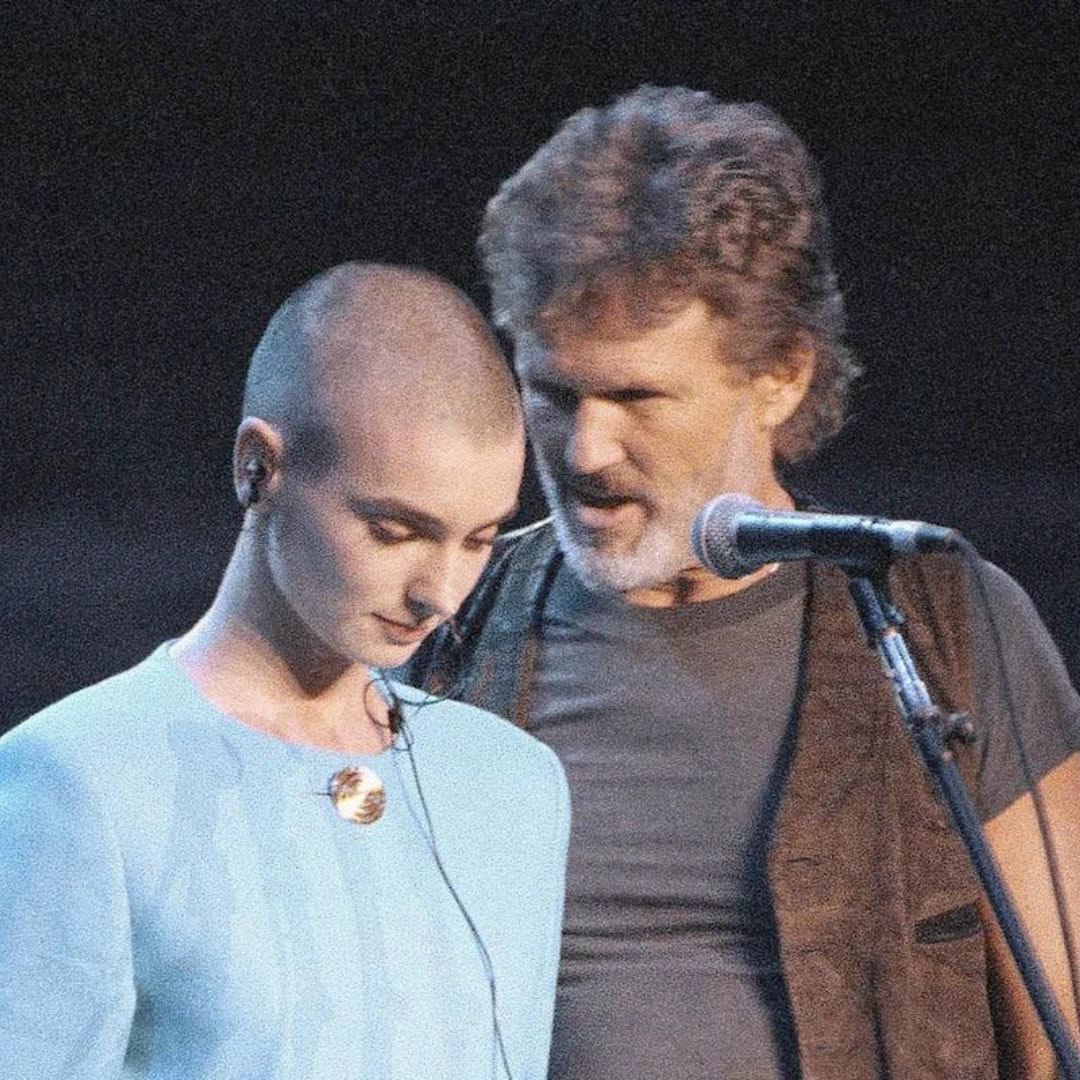
On October 16, 1992, Kris Kristofferson faced a moment that would remain one of the most unforgettable scenes of a remarkable career.
Thousands of people had gathered at Madison Square Garden in New York City to celebrate Bob Dylan’s 30 years in the recording business. The concert featured some of the biggest names in music, including Johnny Cash, Willie Nelson, Eric Clapton, and George Harrison.
But one performance would be remembered for reasons that had little to do with the music.
When 25-year-old Irish singer Sinéad O’Connor walked onto the stage, loud boos erupted from the audience.
Kris Kristofferson was told to get Sinéad O’Connor off the stage.
Instead, Kris Kristofferson walked out to stand beside her.
The Night the Crowd Turned Against Sinéad O’Connor
Just two weeks earlier, Sinéad O’Connor had caused a national controversy during an appearance on Saturday Night Live. Sinéad O’Connor had torn up a photograph of Pope John Paul II as a protest against abuse and institutional wrongdoing within the Catholic Church.
The reaction was immediate and fierce. By the time Sinéad O’Connor arrived at Madison Square Garden, the controversy had followed the Irish singer into one of America’s most famous concert venues.
Sinéad O’Connor had been scheduled to perform Bob Dylan’s I Believe in You.
But the crowd would barely allow the performance to begin.
Kris Kristofferson later recalled that someone running the show instructed Kris Kristofferson to remove Sinéad O’Connor from the stage.
Kris Kristofferson refused.
Walking toward Sinéad O’Connor, Kris Kristofferson offered a brief message of encouragement, urging the young singer not to let the hostile audience bring her down.
Sinéad O’Connor answered with three words:
“I’m not down.”
Instead of singing the planned Bob Dylan song, Sinéad O’Connor waved off the accompanying musicians and delivered an unaccompanied rendition of Bob Marley’s War.
When the performance ended, Sinéad O’Connor left the stage visibly upset. Kris Kristofferson was there again, offering an embrace as the audience continued reacting.
Why Kris Kristofferson Understood That Moment
For Kris Kristofferson, the incident was more than an uncomfortable moment during a concert.
In a 2010 interview with The Irish Times, Kris Kristofferson explained that throughout his career, certain audiences had rejected Kris Kristofferson because of outspoken political and social views.
Kris Kristofferson knew what it felt like to be booed for expressing a belief.
What particularly troubled Kris Kristofferson was that the hostility occurred at a celebration of Bob Dylan, an artist whose music had long been associated with challenging established ideas.
But the connection between Kris Kristofferson and Sinéad O’Connor did not end in 1992.
The Song Kris Kristofferson Wrote for Sinéad O’Connor
On September 29, 2009, Kris Kristofferson released the album Closer to the Bone, produced by Don Was.
Among its deeply personal recordings was a song titled Sister Sinéad.
The song was a tribute to Sinéad O’Connor.
Rather than simply retelling the confrontation at Madison Square Garden, Sister Sinéad reflected on the courage required to speak out when the world was unwilling to listen.
In the 2010 interview, Kris Kristofferson connected the song to the growing public revelations of abuse within church institutions and to the message Sinéad O’Connor had tried to communicate years earlier.
The song expressed a sense that Sinéad O’Connor had been condemned without many people understanding the concerns behind the original protest.
It was not a commercial country hit like Sunday Mornin’ Comin’ Down or Help Me Make It Through the Night.
It was something more personal: one songwriter’s acknowledgment of another artist’s courage.
A Friendship Remembered Through Music
There was another meaningful chapter in 2010.
During an appearance on Irish television’s Saturday Night with Miriam, Kris Kristofferson and Sinéad O’Connor performed Help Me Make It Through the Night together.
Nearly eighteen years after that difficult evening in New York, the two artists were sharing a song rather than facing an angry crowd.
Sinéad O’Connor died in July 2023. Kris Kristofferson died in September 2024.
Today, the footage of the 1992 concert remains a powerful reminder of a moment when compassion mattered more than pleasing an audience.
And Sister Sinéad preserves another part of that history.
For all the celebrated songs Kris Kristofferson wrote about love, loneliness, and freedom, this lesser-known recording tells a particularly human story.
Sometimes the most meaningful tribute is not written for a chart position or an award.
Sometimes it begins when one person refuses to turn away from another.