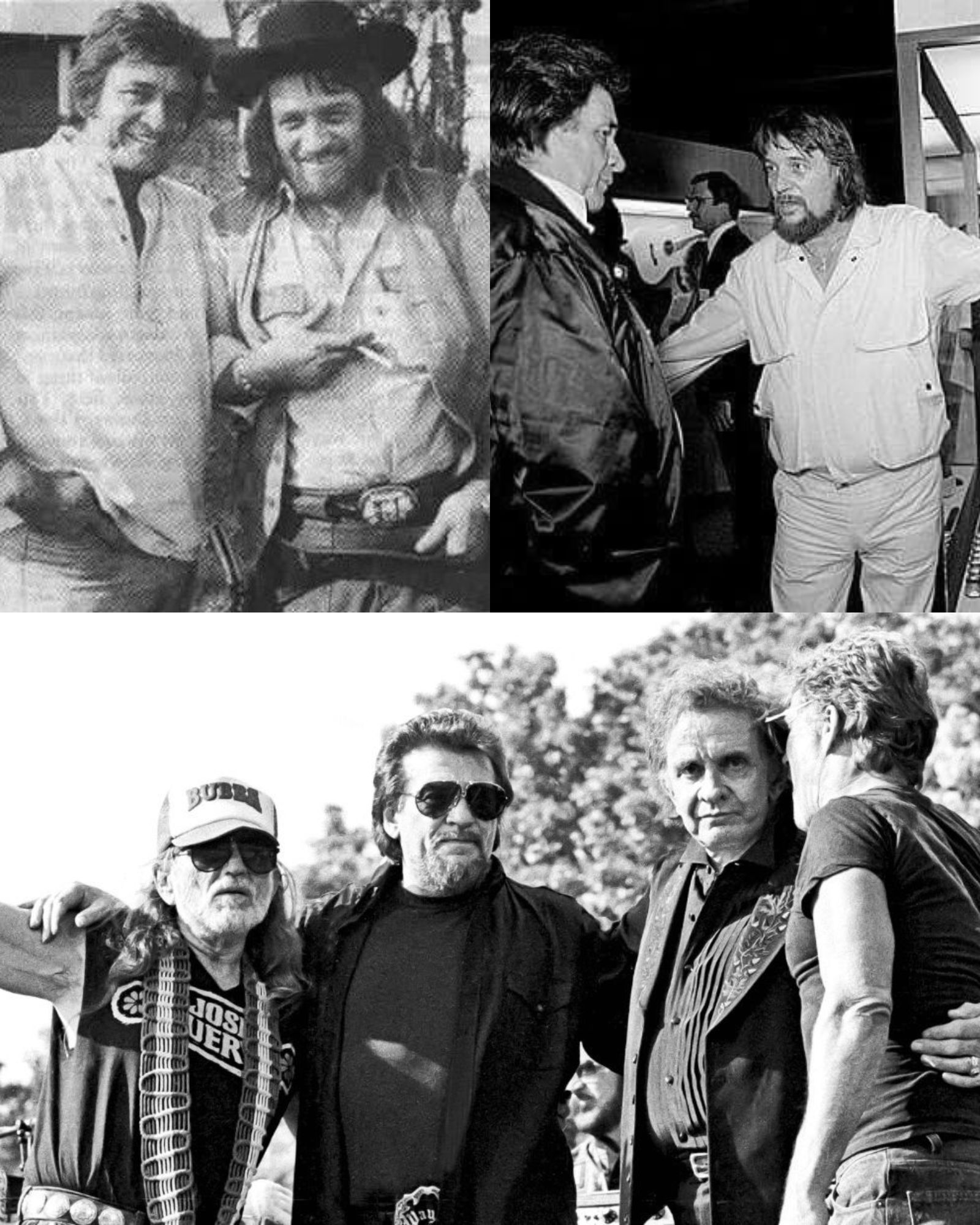
In November 1957, Johnny Cash recorded a song about a man following the woman he loved down the Mississippi River. It was a fast-moving story filled with heartbreak, small towns, and a river that seemed to understand more than the people living beside it.
But when the record was released, one part of the story was missing.
Nearly three decades later, Johnny Cash returned to that same song with Willie Nelson, Waylon Jennings, and Kris Kristofferson. This time, the missing verse was included. And instead of singing it himself, Johnny Cash let Waylon Jennings take that part.
The song was “Big River,” and the story behind that forgotten verse makes the 1985 recording particularly special.
It Began at Sun Records in 1957
Johnny Cash recorded “Big River” on November 12, 1957, during the years when Sun Records in Memphis was helping establish Johnny Cash as one of America’s most distinctive singers.
Released as a single in early 1958, “Big River” became a country hit, reaching No. 4 on Billboard’s country chart.
Johnny Cash had written a clever story about a man who meets a woman in St. Paul, Minnesota, and falls hopelessly in love. When the woman disappears, the man follows her trail down the Mississippi River.
The journey takes the listener through Davenport, St. Louis, and Memphis, with the heartbroken traveler eventually imagining the woman continuing toward Baton Rouge and New Orleans.
But there was another stop on that journey.
Johnny Cash had written an additional verse about Natchez, Mississippi.
That verse was omitted from the original Sun Records master because of the recording’s length.
For listeners who knew only the hit single, part of the man’s emotional journey remained unheard.
The Missing Verse Told a More Personal Story
In the omitted passage, the traveler reaches Natchez, a historic Mississippi River town between Memphis and Baton Rouge.
The woman is still nowhere to be found. The man continues his journey, but the mood changes. When the rain begins falling, the traveler realizes that nobody can see the tears on his face.
It is a small moment, but an important one.
Throughout “Big River,” Johnny Cash makes the Mississippi River almost another character. The river carries news of the missing woman, guides the traveler from town to town, and becomes the silent witness to his heartbreak.
The Natchez verse brings the listener closer to the man behind the restless journey. Instead of simply following the woman, the traveler begins revealing how deeply the search has hurt him.
Johnny Cash did sometimes perform the omitted verse in other versions over the years. But it was absent from the familiar 1958 single that had introduced so many listeners to the song.
Waylon Jennings Brought the Verse Back in 1985
In the mid-1980s, Johnny Cash joined Willie Nelson, Waylon Jennings, and Kris Kristofferson to record the first Highwaymen album, produced by Chips Moman.
The album, released in May 1985, brought together four artists whose careers had already changed country music.
Among its ten tracks was a new recording of “Big River.”
This version offered something the original hit record had not. The four singers took turns carrying the story, each contributing a distinctive voice to Johnny Cash’s composition.
And when the journey reached Natchez, Waylon Jennings sang the long-omitted verse.
It was a fitting choice. Waylon Jennings had a rough-edged, unmistakable delivery that suited the weary traveler and the frustration running through the song.
The restored passage also gave all four Highwaymen a place in the larger narrative.
Nearly thirty years after the original recording, the song’s journey down the Mississippi River sounded more complete.
What Kris Kristofferson Said in 1991
The story gained another memorable chapter in 1991, when The Highwaymen appeared together for an interview with New Zealand broadcaster Paul Holmes.
During the conversation, the four country legends were asked to identify the greatest country songs ever written.
Kris Kristofferson did not choose one of his own compositions.
Instead, Kris Kristofferson named Johnny Cash’s “Big River.”
Kris Kristofferson went even further, explaining that he had often considered it one of the finest songs ever written, regardless of musical genre.
Johnny Cash was sitting beside Kris Kristofferson as the compliment was delivered.
It was a remarkable expression of respect from one celebrated songwriter to another.
One Song, Four Voices, and a Missing Piece of History
What makes the Highwaymen version of “Big River” memorable is not simply the presence of four famous voices.
It is the way Johnny Cash’s early songwriting found new life among friends who understood the music and respected the man who created it.
Johnny Cash had written the song as a young artist in the 1950s. Waylon Jennings helped bring the omitted Natchez verse back to a major studio recording in the 1980s. And Kris Kristofferson’s words in 1991 showed just how highly another great songwriter valued the composition.
Today, listening to the two recordings offers a small but fascinating trip through country music history.
In the original, Johnny Cash tells a compelling story of love and loss. In the Highwaymen version, Johnny Cash, Willie Nelson, Waylon Jennings, and Kris Kristofferson share that story together.
And somewhere along the Mississippi River, in a rainy little moment near Natchez, listeners finally hear the piece that was missing from the record Johnny Cash released all those years before.