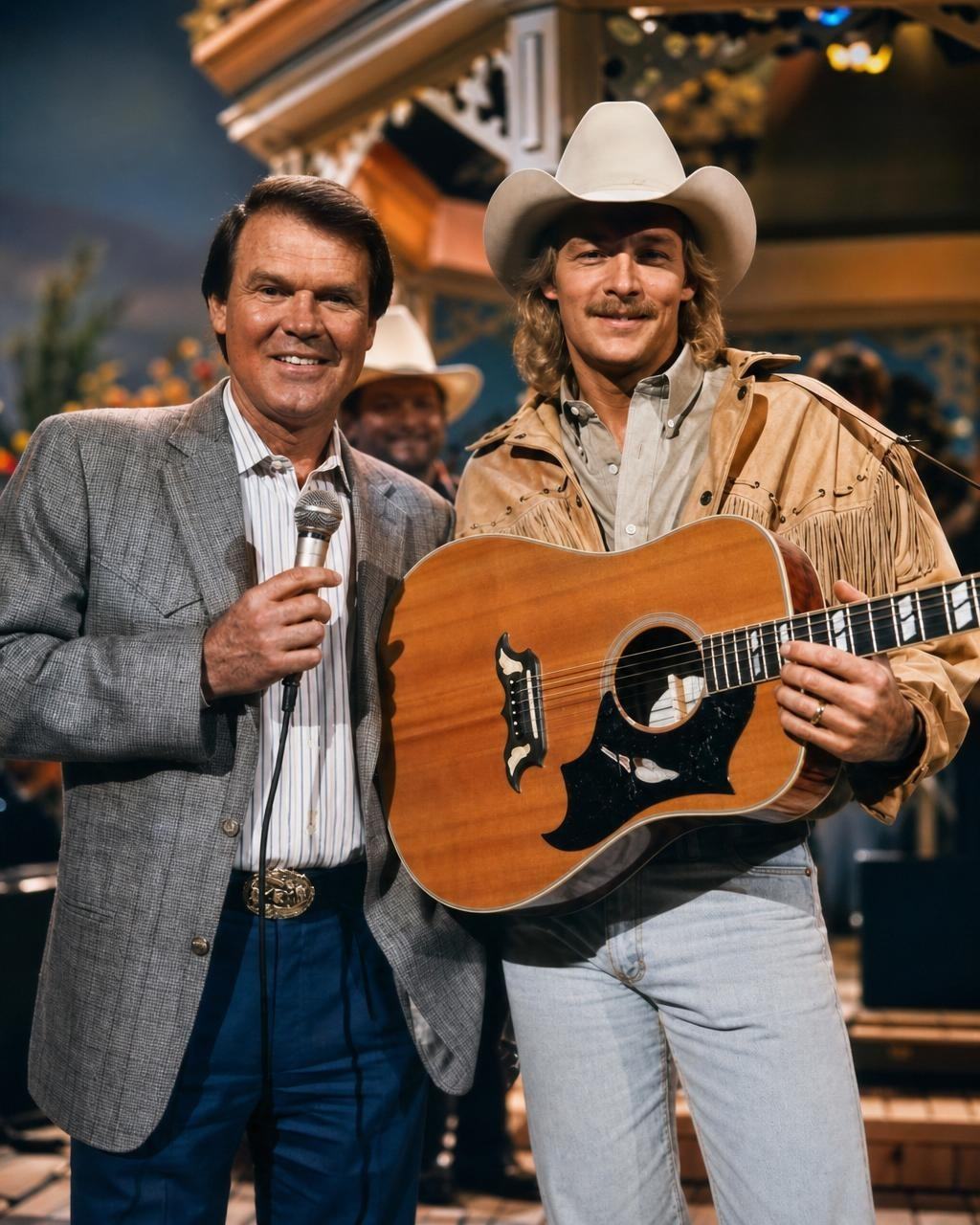
“This May Be Our Only Chance. I Have to Do It.”
In 1985, Denise Jackson was working as a flight attendant in Atlanta when she noticed Glen Campbell in a boarding area. She later said she was not usually the kind of person who walked up to a stranger, but this moment felt different. Denise Jackson knew this was a rare chance, and she decided to take it.
At home in Newnan, Georgia, Alan Jackson was still trying to turn songwriting into a real career. He was writing songs, chasing opportunity, and hoping Nashville would someday open its doors. Denise Jackson stepped into the story first, carrying more courage than she felt and more faith than anyone could have asked for. She approached Glen Campbell and asked for help.
Campbell listened. Instead of brushing her off, he gave Denise Jackson the contact for Marty Gamblin, who ran his publishing company, and told Alan Jackson to prepare a demo. That simple exchange changed everything. Within two weeks, Alan Jackson was sitting in Marty Gamblin’s office, one step closer to the industry he had been reaching for. The connection did not make the journey easy, but it gave the Jacksons a door to walk through.
The Nashville chapter begins
From there, the move to Nashville began to take shape. Alan Jackson kept writing, learning, and pushing forward until his debut album, Here in the Real World, arrived in 1990. The record helped establish Alan Jackson as a major new voice in country music, and one of the songs that followed would become his first Billboard country No. 1. That love song was “I’d Love You All Over Again,” written for Denise Jackson.
The song carried a kind of intimacy that fame could not create on its own. It was rooted in the marriage, the struggle, the waiting, and the belief that the two had already survived enough to know what mattered. The hit was not just a chart milestone. It was a private promise set to music.
A marriage, a memory, and a second look
Years later, after Alan Jackson and Denise Jackson went through a difficult period in their marriage, Alan Jackson turned back to the same shared history that had helped launch his career. He wrote “Remember When,” one of his most personal recordings, and it reflected on love, endurance, family, and time itself. The song became a quiet reminder that the most important parts of a life are often the parts built far from the spotlight.
“Remember when the sound of little feet was the music we danced to week to week.”
So the song that carried the private chapter fame had never fully shown was “Remember When”. It was not only a hit. It was a reflection on the life Alan Jackson and Denise Jackson had lived together, from that airport meeting in 1985 to everything that came after.
Sometimes the biggest stories begin with a small act of courage. Denise Jackson made one choice at an airport in Atlanta, and that choice helped shape a career, a marriage, and a songbook that still feels deeply human.