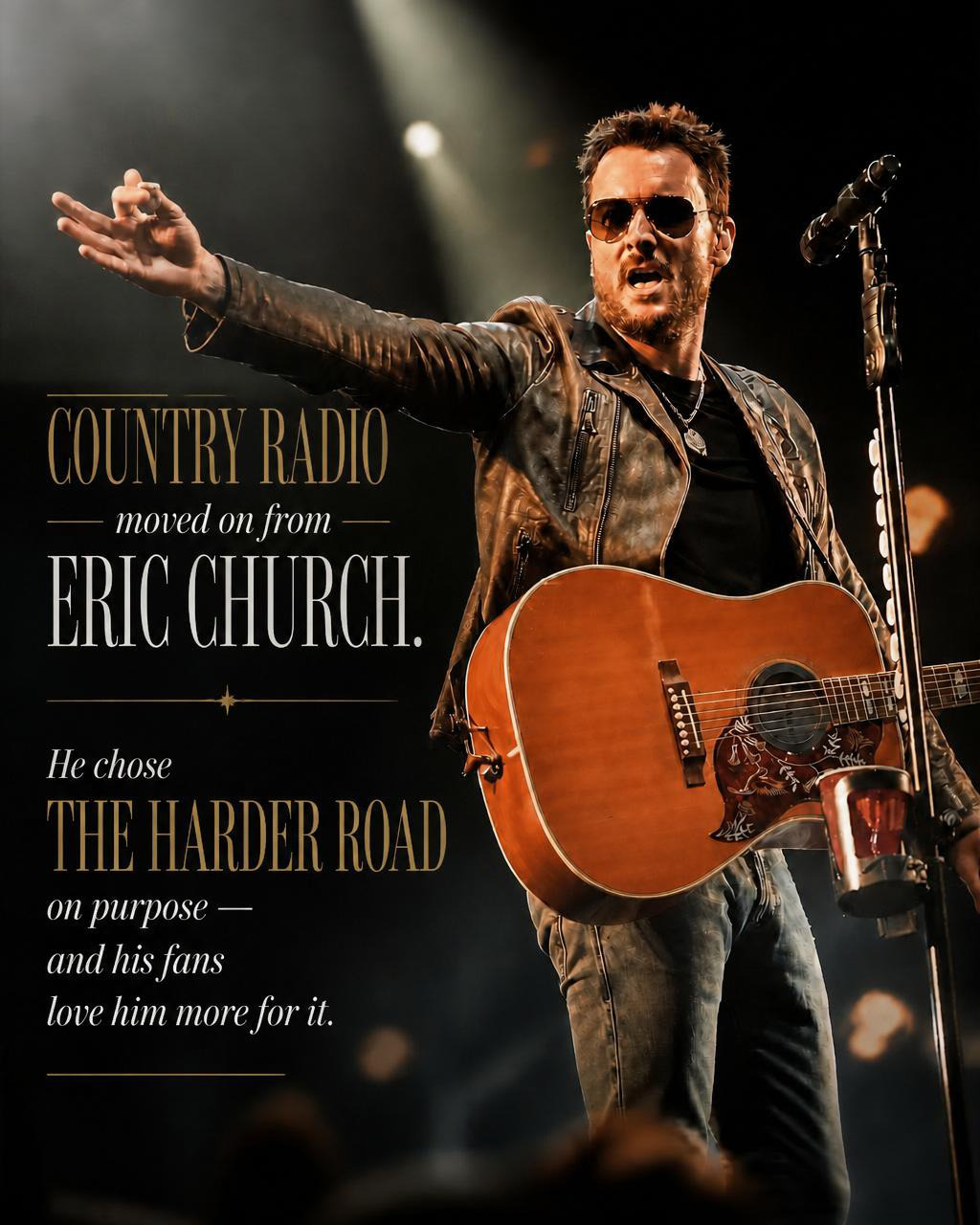
Eric Church Didn’t Lose Country Radio. He Chose the Harder Road — and That May Be Why His Fans Still Follow Him
When “Hell of a View” hit No. 1 in 2021, it felt like Eric Church had found another lane to the top. The song moved slowly and stubbornly, the way the best Eric Church records often do. It did not arrive like a pop event. It did not beg for attention. It simply kept going until radio had no choice but to catch up.
Five years later, Eric Church still has not landed another solo No. 1.
To some people, that might sound like a slide. To Eric Church fans, it sounds more like a choice.
Eric Church has never acted like a country artist built for safe, automatic rotation. From the start, he sounded more interested in pressure than perfection. He has always seemed to work best when he is pushing against something: expectations, comfort, format rules, or even the image people tried to pin on him.
A Career Built on Movement, Not Safety
Country radio has changed a lot, but Eric Church has never depended on it the way some artists do. He has had radio success, no question. He has had major hits, loyal fans, and the kind of live show that turns casual listeners into believers. But the deeper story of Eric Church is not about staying in one lane. It is about refusing to park the car.
That is why “Hands of Time” felt important. It carried nostalgia, but not in a lazy way. It sounded like an artist looking back without getting stuck there. It had heart, memory, and a clear sense of where Eric Church came from.
Then came “Evangeline vs. The Machine”, a project title that sounded like a statement before a single note played. It suggested conflict, ambition, and a little danger. That is what makes Eric Church different: even when the charts are not moving his way, the music still feels alive because it is reaching for something bigger than a simple hit.
Why the Missing No. 1 Might Not Matter
In the old radio model, a No. 1 single was supposed to mean everything. It was proof of momentum, proof of relevance, proof that the machine was working. But Eric Church already has something more difficult to manufacture: trust.
Some singers chase No. 1 because they need proof. Eric Church already has the proof.
That proof is in the crowd that still shows up. It is in the listeners who do not just stream one big song and move on. It is in the people who follow Eric Church because they expect more than comfort from him. They expect honesty. They expect movement. They expect him to take the scenic route if that is where the better song lives.
And that is where the story gets interesting. Eric Church may not be chasing the kind of success that can be measured only by a chart peak. He seems more interested in making music that still asks something of him. Music that costs him a little. Music that does not sound assembled to protect his place.
The Artist Fans Have Stayed With
That is not an easy path. It is often a slower one. It can be riskier. It can even look like resistance from the outside. But fans can usually tell the difference between an artist who has run out of ideas and one who simply refuses to repeat himself.
Eric Church has always sounded like the second kind.
That may be why his audience remains so loyal. They are not just buying a hit song. They are buying into a worldview. They know Eric Church is going to bring attitude, but also vulnerability. He may write about rebellion, but he does it with enough emotional weight to make the songs stick. He is not trying to be easy to understand. He is trying to be real enough to matter.
In a business that often rewards speed, Eric Church has made patience part of the brand. In a genre that sometimes pushes artists toward sameness, he has kept moving toward his own version of country music. That can mean fewer easy victories. It can also mean a longer, stronger relationship with the people who actually listen closely.
Maybe That Is the Real Win
The absence of another solo No. 1 does not erase what Eric Church has built. If anything, it adds another layer to it. He is still here. He is still making records that feel personal. He is still willing to take the harder road when the easier one would probably be more profitable in the short term.
That is not failure. That is nerve.
And in the end, that may be the exact reason Eric Church still matters so much. He never sold himself as a machine built for endless radio domination. He sold himself, song by song, as an artist with something to say. Five years without another solo No. 1 does not change that. It may even prove it.
Eric Church did not lose country radio. He simply stopped asking it to define him.