The Day George Jones Came Home to the Grand Ole Opry
George Jones died on April 26, 2013. George Jones was 81 years old. For country music, the news felt less like a headline and more like a door closing somewhere deep inside the heart of Nashville.
George Jones had been called many things across his long and complicated life: a legend, a survivor, a voice unlike any other, and, simply, “The Possum.” But when the time came to say goodbye, the Grand Ole Opry did something it had not done for an artist’s funeral in 60 years. Not since Hank Williams in 1953 had the Opry opened its doors in that way.
On May 2, 2013, the Grand Ole Opry House became more than a stage. The wooden circle where George Jones had stood so many times became a place of farewell. It was the same sacred spot where George Jones had sung “He Stopped Loving Her Today” again and again, giving country music one of its most heartbreaking prayers.
A Funeral That Felt Like Country Music Itself
Fans lined up the night before. Some came because George Jones had been part of their childhood. Some came because George Jones had helped them through loss, love, divorce, regret, and recovery. Others came because they knew that a voice like George Jones does not belong only to one generation.
Inside the Opry House, the room filled with famous faces and ordinary fans sitting side by side. Kid Rock came. Laura Bush came. Country stars, family members, friends, and listeners all gathered under one roof, not as a crowd at a concert, but as witnesses to the closing chapter of a life that had shaped American music.
There was grief in the room, but there was also gratitude. George Jones had not lived a perfect life, and perhaps that was one reason so many people loved George Jones. George Jones sang as someone who understood weakness, pride, apology, and the terrible cost of loving something too late.
Some singers perform sadness. George Jones seemed to understand it from the inside.
When Vince Gill Could Not Finish the Song
One of the most unforgettable moments came when Vince Gill walked out with Patty Loveless to sing “Go Rest High on That Mountain.” The song was already heavy with meaning, but in that room, on that day, it carried even more weight.
Vince Gill began singing, but emotion caught up with Vince Gill. Halfway through the performance, Vince Gill broke down. Vince Gill could not finish the line. For a moment, the silence said everything words could not.
Patty Loveless stood beside Vince Gill and carried the song to the end. Patty Loveless did not rush it. Patty Loveless did not make the moment bigger than it already was. Patty Loveless simply sang, and the room seemed to breathe with the melody.
It was not polished in the way television usually asks moments to be polished. It was human. It was fragile. It was exactly the kind of moment George Jones himself might have understood.
Alan Jackson and the Song That Belonged to George Jones
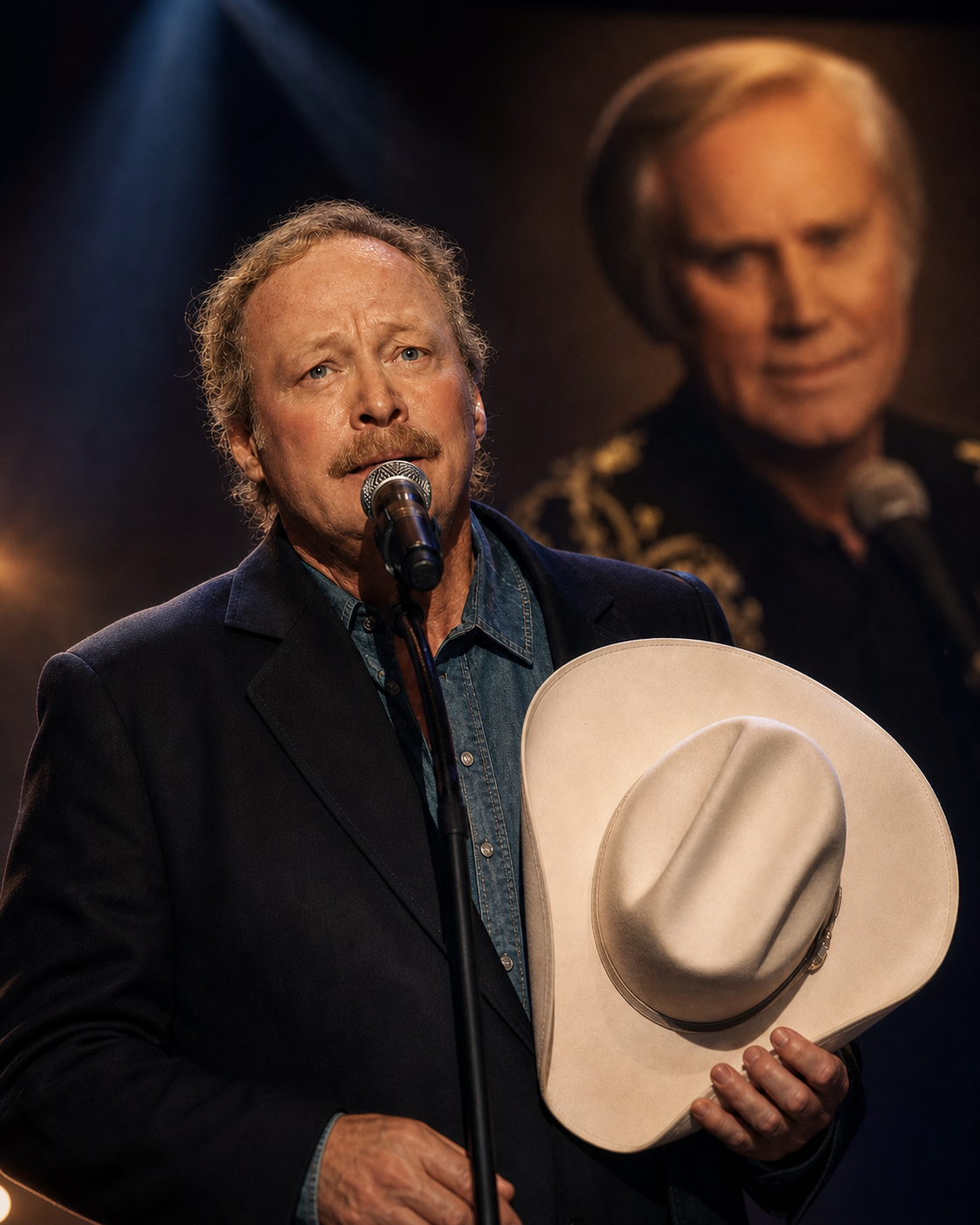
Then Alan Jackson stepped onto the same wooden circle. Alan Jackson sang “He Stopped Loving Her Today,” the song most closely tied to George Jones. That was no easy task. The song was not just a hit record. The song had become part of George Jones’ identity.
Alan Jackson sang it all the way through. The performance was steady, respectful, and deeply restrained. At the final line, Alan Jackson removed his hat and pressed it against his chest. It was a simple gesture, but it said more than a long speech could have said.
For many watching, that moment brought back another night years earlier: the 1999 CMA Awards.
The Night Alan Jackson Defended George Jones
At the 1999 CMA Awards, George Jones had been asked to perform a shortened version of “Choices.” George Jones declined because the song mattered too much to be cut down. Later that evening, Alan Jackson was scheduled to perform “Pop a Top.” But Alan Jackson stopped his own song short and moved into “Choices” instead.
It was not loud protest. It was not a speech. It was a country artist using the stage to honor another country artist. In that moment, Alan Jackson made it clear that George Jones deserved more than a shortened tribute.
Backstage that night, George Jones reportedly told Alan Jackson something simple and unforgettable. George Jones thanked Alan Jackson. The words were not complicated, but the meaning was enormous. George Jones knew Alan Jackson had risked a carefully planned television moment to stand up for George Jones.
Years later, when Alan Jackson stood at the Grand Ole Opry and sang “He Stopped Loving Her Today” at George Jones’ funeral, that old backstage exchange seemed to echo through the room. It felt like one final act of respect between two country singers who understood what a song could mean.
When the Last Curtain Fell
As the service came to an end, the casket left the stage to “When The Last Curtain Falls.” The title alone felt painfully fitting. George Jones had spent a lifetime walking onto stages, facing microphones, and giving audiences pieces of a heart that had been bruised, stubborn, and still singing.
On May 2, 2013, the curtain did fall. But George Jones did not disappear from country music. George Jones remained in every singer who learned that pain can be honest without becoming cruel, that regret can be sung without shame, and that one voice can make a whole room remember someone they lost.
The Grand Ole Opry had opened its doors for George Jones because George Jones was not only a star. George Jones was part of the house itself. The wooden circle had held George Jones’ boots, George Jones’ songs, and finally, George Jones’ goodbye.
And in that final farewell, country music did what country music does best: it remembered, it grieved, and it sang.