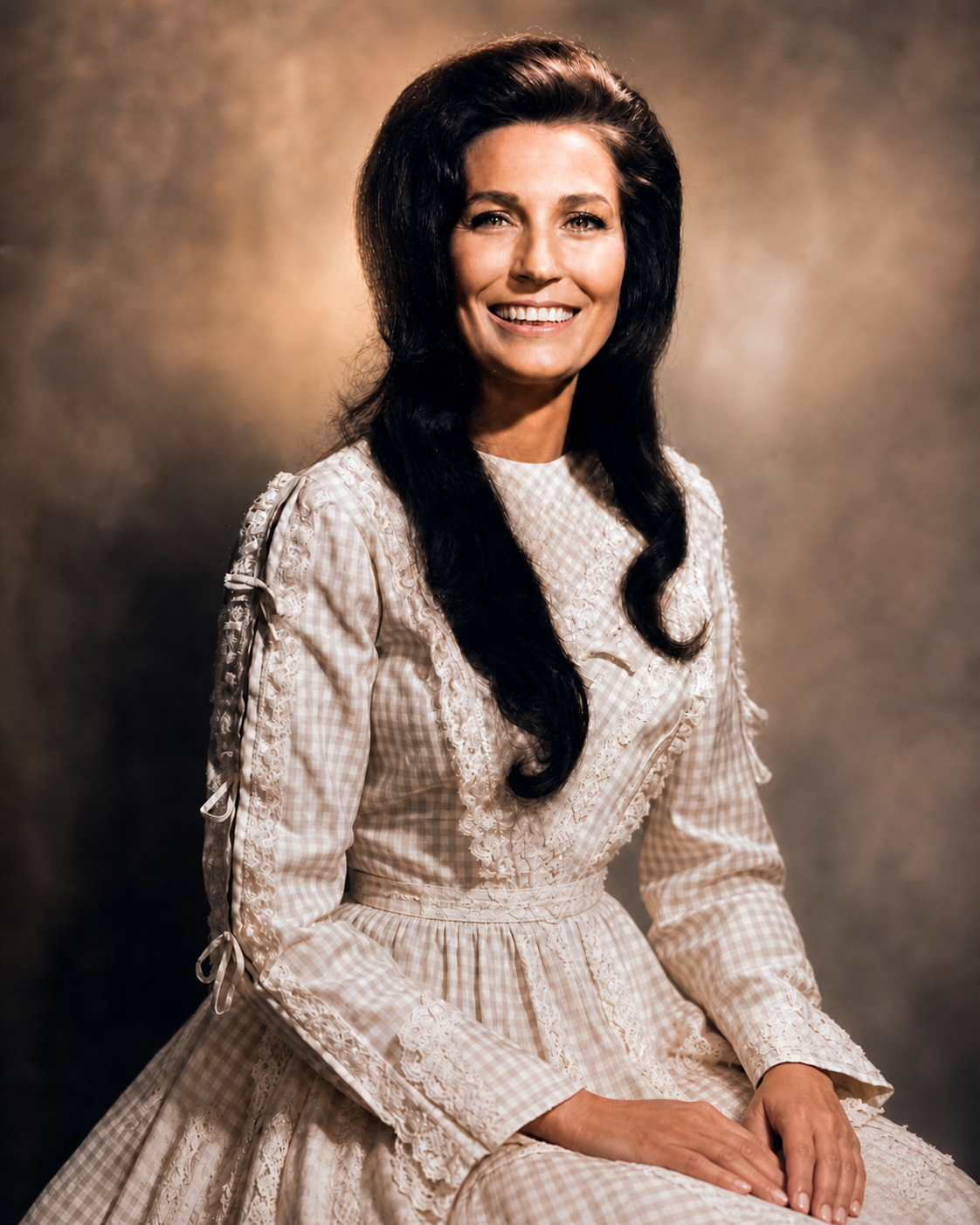
Loretta Lynn and the Song That Carried Her Father Home
Loretta Lynn was 37 years old, a mother of six, and already nearly a decade into her country music career when Loretta Lynn sat down at home in 1969 and began writing “Coal Miner’s Daughter.” By then, Loretta Lynn had lived several lives inside one body. Loretta Lynn had been a child in Butcher Holler, Kentucky. Loretta Lynn had been a teenage wife. Loretta Lynn had become a mother before most girls had finished growing up. And now, after years of singing for crowds, Loretta Lynn was reaching back toward the place that made Loretta Lynn.
The song did not arrive as a polished monument. Loretta Lynn worked through it line by line, wrestling with stubborn words that had to carry the weight of real memory. Holler. Daughter. Water. The melody and the words seemed to come together, but that did not make the task simple. Loretta Lynn was not inventing a character. Loretta Lynn was opening a door to a cabin, a family, and a father who had been gone for ten years.
A Childhood That Would Not Let Go
Loretta Lynn had been born into a world of hard work, close rooms, and deep family loyalty. Loretta Lynn’s father, Melvin “Ted” Webb, worked as a coal miner. Loretta Lynn remembered Melvin “Ted” Webb coming home covered in coal dust, carrying the exhaustion of the mines on his clothes and skin. Melvin “Ted” Webb died in 1959 at the age of 52, long before “Coal Miner’s Daughter” could become the song that would preserve Melvin “Ted” Webb for the world.
That is part of what makes the song ache beneath its simple language. Loretta Lynn was not writing for applause first. Loretta Lynn was writing toward someone who could never answer. The father in the song was not a legend yet. The father in the song was a working man, remembered by a daughter who still saw Melvin “Ted” Webb through the eyes of a child.
Sometimes a song is not written because the world needs to hear it. Sometimes a song is written because the person who lived it still needs to say it out loud.
Nine Verses, Then Three Minutes
When Loretta Lynn finished writing “Coal Miner’s Daughter,” Loretta Lynn had nine verses. That alone says something about the force of the memory. Loretta Lynn had more to say than a country single could hold. Loretta Lynn wanted the cabin, the creek, the mother reading by coal-oil light, the children, the hunger, the pride, and the ache of looking back from a different life.
Producer Owen Bradley understood the music business. Owen Bradley knew that a single could not stretch too long. Owen Bradley listened and told Loretta Lynn that some verses had to be cut. Loretta Lynn agreed, and three or four verses were removed. Those missing pieces were left behind in the studio and eventually lost. Later, Loretta Lynn said Loretta Lynn wished that had not happened.
It is easy to understand why. Those lost verses were not just extra lines. They were fragments of a family history. But even after the cuts, enough remained. More than enough. What survived was lean, clear, and unforgettable. The song did not need ornament. The truth inside it was strong enough.
The Song That Proved Memory Could Climb the Charts
“Coal Miner’s Daughter” was recorded at Bradley’s Barn in 1970 and released that October. By December, the song had reached number one on the country chart. What seemed too personal, too plain, or too rooted in one family’s past became something many listeners recognized in their own hearts.
That was Loretta Lynn’s gift. Loretta Lynn could take a specific detail and make it feel universal. The cabin in Butcher Holler was Loretta Lynn’s cabin, but listeners could see their own childhood homes. The coal-oil light was from Loretta Lynn’s memory, but listeners could feel the warmth of mothers who worked with what they had. The father covered in coal dust was Melvin “Ted” Webb, but listeners heard every parent who labored quietly so their children might have a chance.
Why Loretta Lynn Had to Write It Down
The song later became the title of Loretta Lynn’s 1976 autobiography and the 1980 film that brought Loretta Lynn’s life to an even wider audience. Sissy Spacek’s Oscar-winning performance helped turn Loretta Lynn’s story into American cultural memory. But before the book, before the film, before the awards and admiration, there was a woman at home trying to find the right words for where Loretta Lynn came from.
Maybe Loretta Lynn wrote “Coal Miner’s Daughter” because fame can carry a person far from the dirt road that shaped them. Maybe Loretta Lynn wrote it because success does not erase grief. Maybe Loretta Lynn wrote it because Melvin “Ted” Webb never got to see what Loretta Lynn became, and Loretta Lynn needed to bring Melvin “Ted” Webb with her somehow.
The song did not bring Melvin “Ted” Webb back. No song can do that. But “Coal Miner’s Daughter” gave Melvin “Ted” Webb a place in every room where Loretta Lynn’s voice was heard. Ten years after Melvin “Ted” Webb was gone, Loretta Lynn wrote Melvin “Ted” Webb into three minutes of music that refused to disappear.
And perhaps that is the quiet answer to the question. Loretta Lynn did not write “Coal Miner’s Daughter” only to rescue Loretta Lynn’s father’s memory. Loretta Lynn wrote it because some love remains unfinished until it is spoken, sung, and finally shared.