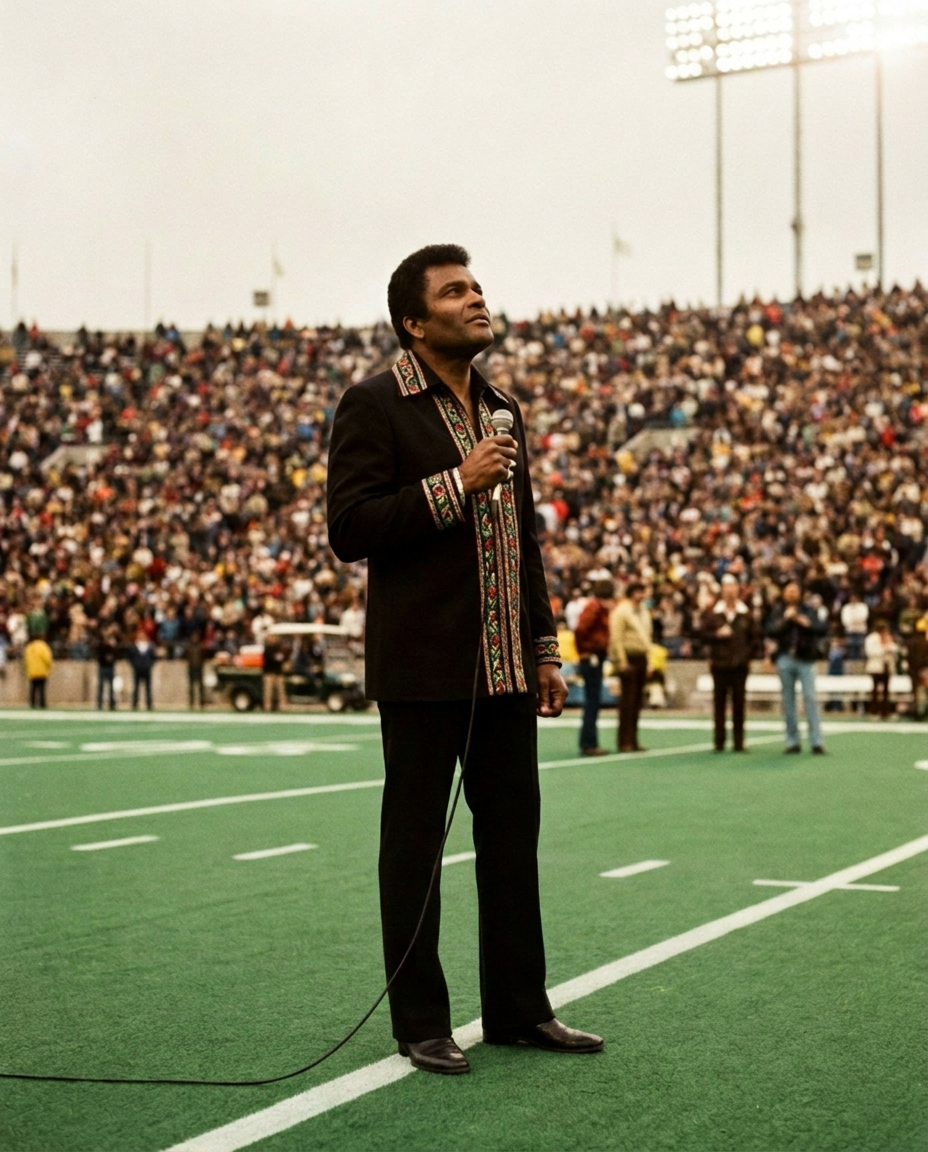
In 1974, Charley Pride Walked Onto a Super Bowl Field and Opened a Door for Country Music
On January 13, 1974, at Rice Stadium in Houston, Texas, the Super Bowl looked very different from the polished, celebrity-filled spectacle the world knows today. There were no massive LED screens, no elaborate pop-star entrances, and no halftime production built like a global concert. The moment before kickoff was simpler, quieter, and in many ways more traditional.
Then Charley Pride walked onto the field.
Before Super Bowl VIII began between the Miami Dolphins and the Minnesota Vikings, Charley Pride stepped up to the microphone to sing The Star-Spangled Banner. It was a brief performance, but it carried a meaning far beyond the length of the song. Charley Pride became the first country singer ever to perform the National Anthem at a Super Bowl, and that one appearance quietly changed the way country music could be seen on one of America’s biggest stages.
A Country Voice in an Unlikely Place
In the early years of the Super Bowl, the National Anthem was often performed by marching bands, instrumentalists, or more traditional ceremonial performers. The idea of a major recording artist standing alone before the game was not yet the standard. The anthem had not become the highly watched cultural moment it later became.
That is what makes Charley Pride’s appearance so important. Charley Pride was not just a successful country singer. Charley Pride was one of the most visible Black performers in country music, a genre that had often been presented to the public through a narrow image. By standing on that field in Houston, Charley Pride brought his voice, his dignity, and his place in country history into a space where many people had never expected to see it.
The performance was not remembered because it was overly dramatic or carefully staged. It was remembered because it was human. Charley Pride reportedly stumbled briefly at the beginning, then steadied himself and finished the anthem with control and sincerity. That small imperfect moment made the performance feel even more real. It was not a polished television fantasy. It was a man standing before a stadium, carrying a historic moment with grace.
Why That Moment Still Matters
Charley Pride’s appearance did not come with a loud announcement about breaking barriers. There was no long speech explaining its importance. But history does not always arrive with thunder. Sometimes it arrives through one person stepping forward and doing the work with quiet courage.
At that time, Charley Pride had already earned respect as one of country music’s most successful artists. Charley Pride had a warm baritone voice, a calm stage presence, and a gift for making songs feel personal. Yet even with that success, his presence at the Super Bowl carried a deeper message. Charley Pride showed that country music belonged on that national stage, and that a Black country artist could stand there with authority, dignity, and pride.
One voice. One microphone. One afternoon in Houston. A door opened wider than many people realized at the time.
For years after Charley Pride’s performance, country artists were still rare in that pregame spotlight. Charley Pride remained the only country artist to sing the National Anthem at the Super Bowl until Garth Brooks did so in 1993. That long gap says a lot about how unusual Charley Pride’s moment truly was.
The Legacy That Followed
When fans later watched artists like Faith Hill, Carrie Underwood, Reba McEntire, Chris Stapleton, and other country voices perform on major national stages, they were seeing a path that Charley Pride helped clear. Every one of those performances belongs to a larger story, and part of that story began at Rice Stadium in 1974.
Charley Pride did not need fireworks to make history. Charley Pride did not need a giant stage or a carefully designed viral moment. Charley Pride only needed a microphone, a song known by millions, and the courage to stand where no country singer had stood before at the Super Bowl.
Looking back, the beauty of that afternoon is in its simplicity. A man walked onto a football field, sang the National Anthem, and left behind something larger than a performance. Charley Pride proved that country music had a place in the Super Bowl tradition. Charley Pride also reminded America that the story of country music is bigger, richer, and more diverse than many people had been taught to believe.
In 1974, Charley Pride did not just sing before a game. Charley Pride quietly changed who gets to stand there.