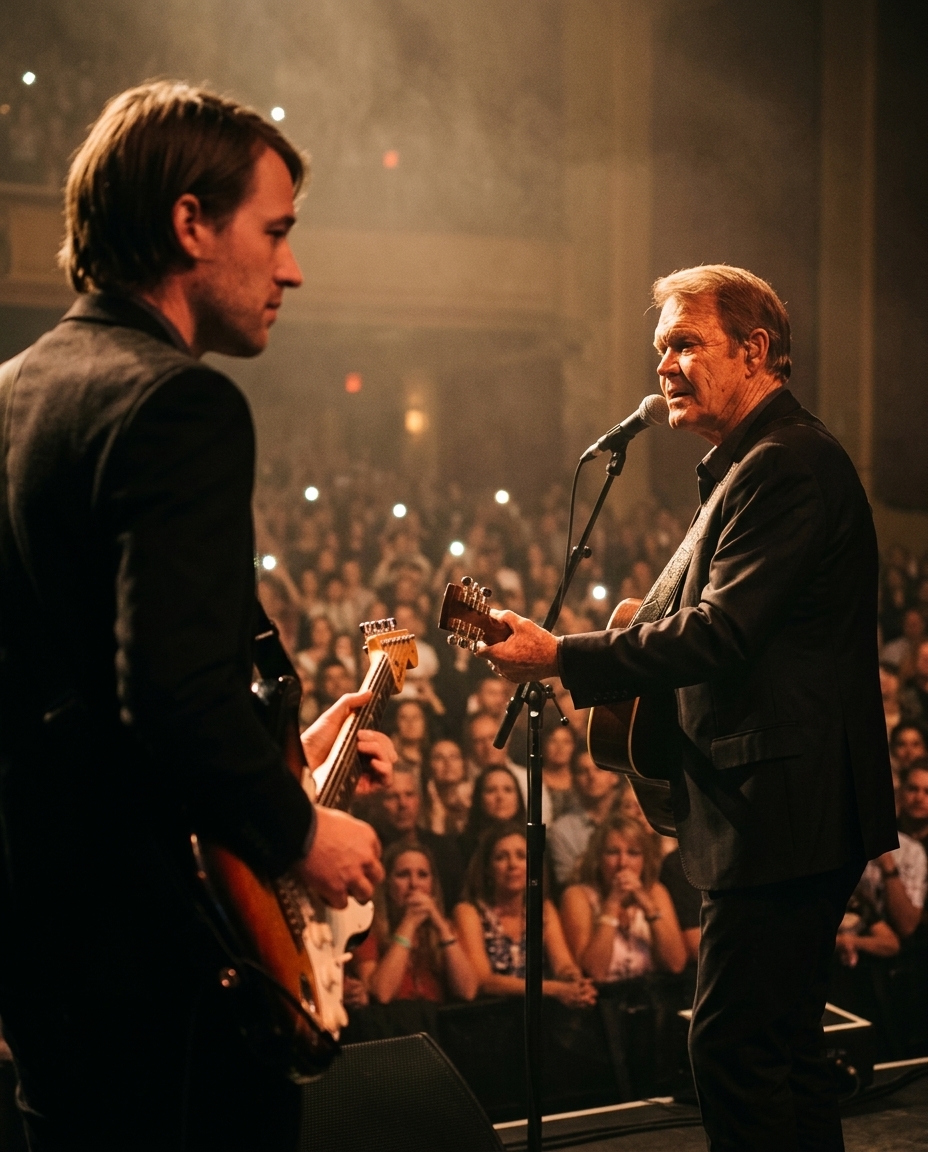
CAL CAMPBELL STOOD TEN FEET BEHIND GLEN CAMPBELL — AND WATCHED MUSIC OUTLAST MEMORY
Cal Campbell was only 14 when Glen Campbell showed him his first chord. It did not happen in a formal lesson room, and it did not feel like a grand moment meant for family history. It happened the way many important things happen in musical families: quietly, almost casually, with a guitar close by and a father who knew exactly when to say just enough.
Glen Campbell took Cal Campbell’s hand, placed his fingers on the strings of an old acoustic, and told him not to overthink it. Just let the hands find it. For Cal Campbell, that sentence became more than advice. It became a way of living around music, pressure, and eventually heartbreak.
He grew up in a home where guitars were everywhere. They were not decoration. They were part of the rhythm of the house. A guitar might lean against a kitchen wall, rest near a bedroom chair, or sit within reach in the bathroom because for Glen Campbell, music was never something to visit. It was always there.
Learning From a Father Who Spoke Through Music
Cal Campbell did not chase applause at first. He chased approval. Not the loud kind, either. He wanted the small things that mattered most in families built on craft: a glance, a quiet smile, a nod that said he had done it right. Glen Campbell was the kind of musician whose standards could be heard in every note, and Cal Campbell practiced like someone who understood that being close to greatness did not guarantee anything. He had to earn his place.
So he kept playing. He played until his fingers were raw. He played until the chord changes stopped feeling like instructions and started feeling like instinct. Somewhere along the way, the son who only wanted to be good enough for his father became a musician strong enough to stand beside him.
When Goodbye Became a Tour
In 2011, everything changed. Glen Campbell revealed that he had been diagnosed with Alzheimer’s disease and announced what would become his farewell tour. It was not a normal farewell. It was brave, public, and deeply personal. Glen Campbell was not stepping away in silence. He was stepping onto stages across the country while the disease was already beginning to alter the shape of daily life.
For the family, joining him was not just a musical choice. It was an act of love. Cal Campbell became part of the touring band, along with Ashley Campbell and Shannon Campbell. From the audience, it may have looked like a gifted family sharing a final chapter together. From inside the band, it was much more fragile than that.
Each night, Cal Campbell stood close enough to admire the genius and close enough to see the damage. That was the painful contradiction of the tour. Glen Campbell could still pick up a guitar and find moments of brilliance that felt untouched. A solo would come alive. A phrase would land perfectly. The old fire would flash so clearly that the crowd could believe nothing had changed.
Then the song would end, and the confusion might return.
Holding the Music Together
Cal Campbell saw the moments most people never saw. He saw the questions backstage. He saw the uncertainty between songs. He saw his father search for details that once would have been effortless. Some nights Glen Campbell forgot where they were. Some nights he needed help finding the road back to the next lyric, the next cue, the next key.
That was where Cal Campbell became more than a guitarist in the band. He became part musician, part guide, part son trying not to let the room notice what was slipping away. He adjusted quietly. He filled space without making it obvious. He protected the shape of the performance so the audience could stay inside the music, even while he was standing inside something much heavier.
He was playing guitar for his hero, and at the same time watching that hero drift further away one concert at a time.
That is what made the Goodbye Tour so moving. It was never only about nostalgia. It was about dignity. It was about a family choosing to meet loss with rhythm, discipline, and love. The tour stretched to 151 shows over three years, and with each performance, the balance became harder to maintain.
The Weight of the Final Night
By the final show in 2014, the emotion surrounding Glen Campbell had changed from admiration alone to something closer to collective protection. People were not just watching a legend perform. They were witnessing a family carry one another through something neither talent nor fame could stop.
For Cal Campbell, that final concert was not simply the end of a tour. It was the end of a long act of holding steady. Every rehearsal, every chord, every glance across the stage had been part of a promise: keep playing, keep the song standing, keep Dad surrounded by the thing he loved most for as long as possible.
And then it was over.
What happened backstage after the final show feels larger because it has never been fully turned into a public story. That silence says something of its own. Maybe the last thing Glen Campbell said to Cal Campbell was too personal to repeat. Maybe it was clear. Maybe it was fragmented. Maybe it was one of those rare lines that matters less for its exact wording than for the fact that it existed at all.
But perhaps that is why the story stays with people. Not because every detail is known, but because the feeling is easy to understand. A son learned music from his father. Years later, that son used the same music to help carry his father through the hardest chapter of his life. There is something deeply human in that circle.
Cal Campbell did not just stand on stage for Glen Campbell’s farewell. Cal Campbell stood there as proof that memory can fade, language can fail, and time can take almost everything, yet a song can still travel from one pair of hands to another and survive.
In the end, that may have been Glen Campbell’s final lesson. Keep playing. Even when the moment hurts. Even when the silence afterward is too sacred to explain.